
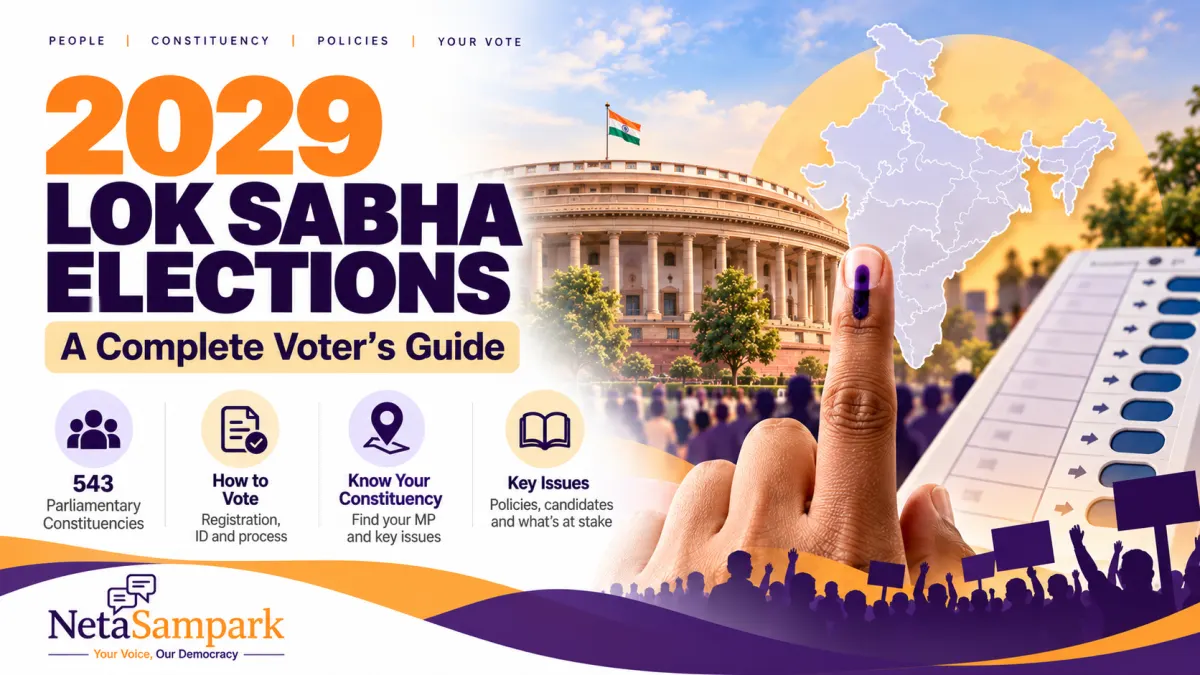
2029 Lok Sabha Elections in India: Dates, Voter Guide, Constituencies and What to Know
India’s 2029 Lok Sabha elections will be one of the country’s most significant democratic events, giving voters the opportunity to elect the Members of Parliament who will represent them in the lower house of Parliament and help determine the next Union government.
The election will bring national leadership, economic priorities, employment, public services, infrastructure, governance and local representation into focus. For voters, understanding the election process is just as important as following political campaigns.
This comprehensive guide explains what to expect from the 2029 Lok Sabha elections, how the electoral system works, how to check your voter registration, how to find your constituency and candidates, and how to make an informed voting decision.
Important: As of October 2026, the Election Commission of India has not announced the official schedule for the 2029 Lok Sabha elections. Dates and timelines in this guide are indicative and may change.
2029 Lok Sabha Elections: Overview
| Particular | Details |
|---|---|
| Election | 2029 Indian General Election |
| Purpose | Election of Members of the Lok Sabha |
| House | Lok Sabha, the lower house of Parliament |
| Current elected-seat count | 543 parliamentary constituencies |
| Current Lok Sabha term | 24 June 2024 to 23 June 2029, as listed by the ECI |
| Expected election period | Before the current Lok Sabha’s term ends, subject to constitutional and electoral requirements |
| Voting method | Secret ballot using Electronic Voting Machines (EVMs), with VVPAT verification slips |
| Election authority | Election Commission of India |
| Official dates | Not announced as of October 2026 |
Source: Election Commission of India — Terms of the Houses and ECI voter information.
What Are the 2029 Lok Sabha Elections?
The Lok Sabha elections are national elections held to choose representatives to the House of the People, the lower house of India’s Parliament.
India is divided into parliamentary constituencies. Each constituency elects one Member of Parliament (MP) to represent its voters in the Lok Sabha.
The party or coalition that can command the confidence of a majority of Lok Sabha members can form the Union government. The President appoints the Prime Minister, who heads the Council of Ministers.
The election therefore has two closely connected outcomes:
- Constituency representation: Voters choose the MP who will represent their parliamentary constituency.
- Government formation: The overall distribution of seats determines which party or coalition is positioned to form the Union government.
A candidate does not need to belong to the party that wins the most seats nationally to win an individual constituency. The winner is determined constituency by constituency.
When Will the 2029 Lok Sabha Elections Be Held?
The exact dates will be announced by the Election Commission of India.
The current Lok Sabha’s term is listed by the ECI as ending on 23 June 2029. On the basis of the normal five-year term, the next general election is expected before the current House’s term expires, unless the Lok Sabha is dissolved earlier or another constitutional development changes the timeline.
India’s general elections are often conducted in multiple phases rather than on a single day. The schedule depends on factors such as security arrangements, the availability of election personnel, logistics, weather and the number of polling stations.
Expected election timeline
| Stage | Expected timing |
|---|---|
| Official election announcement | To be decided by the ECI |
| Election notifications and nominations | As specified in the official schedule |
| Scrutiny and withdrawal of nominations | As specified in the official schedule |
| Polling | May take place in multiple phases |
| Counting and results | On the date announced by the ECI |
| Formation of the new government | Following the election results and constitutional process |
These are the usual stages of a general election, not confirmed dates for 2029.
Where to check official updates: Visit the Election Commission of India and its General Elections portal.
How Many Seats Are There in the Lok Sabha?
The current Lok Sabha has 543 elected seats, with each seat representing a parliamentary constituency.
The election is not decided by the national popular vote alone. Instead, votes are counted separately in each constituency, and the candidate who receives the highest number of valid votes wins that seat.
For example, a party may receive a substantial share of votes across India but win fewer seats than another party whose votes are distributed more efficiently across constituencies. This is because the electoral outcome depends on individual constituency results.
The number and boundaries of constituencies, along with the applicable legal framework, should always be checked against official information closer to the election.
How Does the Lok Sabha Election Process Work?
The general election follows a series of legal and administrative steps overseen by the Election Commission of India.
1. Election announcement
The ECI announces the election schedule, including polling phases, nomination deadlines and counting dates. The Model Code of Conduct comes into effect following the announcement, according to the applicable election rules.
2. Candidate nominations
Eligible candidates submit their nomination papers within the prescribed period. Election officials scrutinise the nominations, and candidates may withdraw within the specified deadline.
3. Election campaigning
Political parties and candidates campaign to present their policies, achievements, proposals and priorities. Voters can use this period to examine manifestos, candidate backgrounds and public commitments.
4. Polling
Eligible voters whose names appear on the electoral roll can cast their votes at their designated polling stations. Polling is conducted under the supervision of election officials.
5. Counting of votes
Votes are counted according to the ECI’s procedures. Results are declared constituency by constituency.
6. Government formation
The seat distribution determines which party or coalition can command the confidence of the Lok Sabha. The constitutional process then enables the formation of the Union government.
For an explanation of the formal stages, refer to the ECI’s voter education resources.
Who Can Vote in the 2029 Lok Sabha Elections?
To vote in a parliamentary constituency, a person generally needs to meet the following requirements:
- Be an Indian citizen.
- Be at least 18 years old on the applicable qualifying date.
- Be ordinarily resident in the constituency where they seek registration.
- Be eligible for enrolment under the applicable election laws.
- Have their name included in the relevant electoral roll.
Having a Voter ID card alone is not sufficient if your name is missing from the electoral roll. Voters should check their enrolment status before polling.
Official guidance: ECI — How to Register to Vote.
How to Register as a New Voter
If you are eligible to vote but have not registered, you can apply through the Election Commission’s Voters’ Services Portal.
Steps to register online
- Visit voters.eci.gov.in.
- Find the new voter registration service.
- Complete Form 6, which is generally used by eligible Indian citizens applying for registration as general electors.
- Enter the required personal and residence details accurately.
- Submit the supporting information or documents requested by the portal.
- Save your application reference number and track the application status.
- Once processed, check the electoral roll to confirm that your name has been included.
The application process and applicable qualifying dates should be checked on the official portal.
What if you have moved to another city?
If you have moved, need to correct an existing entry or require a replacement EPIC, use the appropriate service, generally Form 8, subject to the applicable rules.
Do not submit multiple registrations for the same person in different constituencies. Follow the ECI’s instructions for shifting your registration.
Useful links:
How to Check Your Name in the Voter List
Before the 2029 election, verify that your name appears in the electoral roll.
You can do this by:
- Visiting electoralsearch.eci.gov.in.
- Searching using the details or identification information supported by the portal.
- Confirming your name, constituency and polling information.
- Checking your polling station and other available details.
- Contacting the election helpline or your local election officials if there is an issue.
The ECI also provides voter assistance through 1950. Check the official website for current contact instructions and service availability.
Do not wait until election day to discover that your registration is missing or incorrect.
How to Find Your Lok Sabha Constituency and MP
Every parliamentary constituency elects one MP to the Lok Sabha. Knowing your constituency helps you identify the candidates contesting the seat and understand who represents your area in Parliament.
To find your constituency:
- Use the ECI’s electoral search and voter services.
- Check your constituency details through official election resources.
- Review the official candidate list once it is published for the election.
- Use parliamentary records to review the work and participation of your sitting MP.
You can start with the ECI Voters’ Services Portal and the official Parliament of India website.
Remember that a parliamentary constituency is different from an Assembly constituency, municipal ward or Gram Panchayat area. These represent different levels of government.
How to Evaluate Candidates in the 2029 Election
An informed vote requires looking beyond campaign slogans, party symbols and social media popularity. Voters can compare candidates using publicly available information and their own assessment of local needs.
1. Review the candidate’s background
Check the candidate’s official nomination information and affidavit when it becomes available. Relevant information may include declared assets and liabilities, educational details and criminal cases disclosed in the required documents.
A declaration should be interpreted carefully and in context. An allegation or pending case is not the same as a conviction.
2. Examine previous performance
For a sitting MP seeking re-election, review their parliamentary participation, questions, debates, committee work and other publicly documented activities where information is available.
Also examine whether the MP has engaged with constituents and raised important local issues.
3. Compare policy commitments
Read party manifestos and candidate statements. Look for specific proposals, clear priorities, implementation plans and measurable commitments rather than broad promises alone.
4. Understand the candidate’s local priorities
Consider issues affecting your constituency, including employment, roads, public transport, water, healthcare, education, agriculture, industry, pollution and public safety.
The relevance of each issue will vary by location.
5. Verify claims before sharing them
Election campaigns can generate misleading statistics, edited videos, old images presented as new, and claims taken out of context.
Where possible, verify information through official records, original speeches, credible reporting and primary documents.
6. Compare candidates fairly
Use the same criteria to evaluate every candidate. Consider their record, proposals, credibility, responsiveness and ability to represent constituency interests.
The aim is not simply to identify the most popular candidate, but to make a decision based on evidence and your priorities.
What Issues Could Matter in the 2029 Lok Sabha Elections?
The final set of election issues will depend on developments between now and the campaign period. The following are areas voters may wish to examine, not predictions of the issues that will dominate the election.
Employment and economic opportunity
Voters may assess job creation, wages, labour-force participation, entrepreneurship, manufacturing, investment and opportunities for young people.
It is useful to distinguish between announcements, budget allocations, completed projects and independently measured outcomes.
Cost of living and household finances
Food prices, housing, education, healthcare, transport and energy costs affect household budgets. Voters can examine how policy proposals address affordability and whether supporting evidence is available.
Agriculture and rural livelihoods
Farm incomes, irrigation, agricultural markets, crop insurance, rural infrastructure, access to credit and climate resilience may be important in many constituencies.
Education and skills
Voters can assess the quality of public education, access to higher education, vocational training, digital skills and the connection between training programmes and employment.
Healthcare and social protection
Public health infrastructure, affordability of treatment, insurance coverage, nutrition and access to essential services are relevant to many households.
Infrastructure and urban development
Roads, railways, public transport, logistics, housing, sanitation, water supply and urban planning can shape the quality of life in cities and towns.
Governance and accountability
Transparency, public-service delivery, corruption prevention, institutional accountability, grievance redressal and the implementation of laws may feature in voters’ assessments.
Environment and climate resilience
Air pollution, water security, extreme heat, floods, forest conservation and disaster preparedness may be especially important in affected regions.
National security and foreign policy
National security, border management, defence preparedness and India’s international relationships are among the responsibilities of the Union government.
Voters can examine the evidence, policy proposals and trade-offs presented by different parties.
What Is the Difference Between Lok Sabha and State Assembly Elections?
India has elections at several levels of government, and each serves a different purpose.
| Feature | Lok Sabha election | State Assembly election |
|---|---|---|
| Representatives elected | Members of Parliament (MPs) | Members of Legislative Assembly (MLAs) |
| Institution | Lok Sabha, Parliament of India | State Legislative Assembly |
| Government formed | Union government | State government |
| Main leadership | Prime Minister and Union Council of Ministers | Chief Minister and state Council of Ministers |
| Typical policy responsibilities | National policy, defence, foreign affairs, Union taxation and other Union responsibilities | State responsibilities such as public health, police and agriculture, subject to constitutional divisions |
| Constituencies | Parliamentary constituencies | Assembly constituencies |
A parliamentary constituency may contain several Assembly constituencies. As a result, the MP and MLA representing the same locality may be different people and may belong to different political parties.
The Lok Sabha election does not directly elect the Prime Minister through a separate nationwide ballot. Voters elect their constituency’s MP, and the government is formed through the parliamentary system.
How Does Voting Work on Election Day?
The ECI provides official instructions for voters. The following is a general overview; follow the directions given by polling officials on the day.
- Check your name in the electoral roll and identify your assigned polling station.
- Carry an accepted identity document as specified by the ECI.
- At the polling station, officials verify your eligibility and complete the required formalities.
- Follow the instructions to cast your vote using the Electronic Voting Machine (EVM).
- The Voter Verifiable Paper Audit Trail (VVPAT) displays a slip showing the selected candidate’s details for a brief period.
- Follow polling officials’ instructions before leaving the polling station.
A voter may select NOTA — “None of the Above” — if they do not wish to vote for any of the listed candidates. NOTA does not function as a mechanism for automatically cancelling the election or requiring a fresh poll.
Mobile phones and other items may be restricted inside polling stations. Check the ECI’s instructions before you go.
Official instructions: How to Vote — Election Commission of India.
How Can Citizens Participate Beyond Voting?
Democratic participation does not end when a voter leaves the polling station. Citizens can stay involved in public affairs throughout the parliamentary term.
Ways to participate include:
- Attend public meetings and constituency consultations.
- Raise local issues through official grievance mechanisms.
- Track government schemes, public works and service-delivery commitments.
- Read parliamentary questions, debates and committee reports.
- Participate in lawful, peaceful civic initiatives.
- Ask elected representatives for updates on constituency issues.
- Share verified information about voting and voter registration.
- Encourage eligible family members and friends to check their electoral registration.
Citizens should respect election laws, privacy and the rights of others when participating in political discussions or civic activities.
How to Follow Official Election Updates
As the 2029 election approaches, voters should rely on official information for schedules, electoral rolls, candidates and polling arrangements.
| Information needed | Official resource |
|---|---|
| Election announcements and schedules | Election Commission of India |
| General election information | ECI General Elections |
| Voter registration and corrections | Voters’ Services Portal |
| Name in the electoral roll | Electoral Search |
| Voting procedure | How to Vote |
| Registration eligibility and forms | How to Register to Vote |
| Parliament and parliamentary records | Sansad — Parliament of India |
The official schedule should be treated as authoritative. Media reports, political announcements and online posts may provide context, but they should not be mistaken for the formal election notification.
Frequently Asked Questions About the 2029 Lok Sabha Elections
1. When are the 2029 Lok Sabha elections?
The exact dates have not been announced as of October 2026. The current Lok Sabha’s term is listed by the ECI as ending on 23 June 2029, so the next general election is expected before the term expires under the normal constitutional timetable, subject to any changes.
2. How many seats are being contested?
The current Lok Sabha has 543 elected seats. Voters in each parliamentary constituency elect one MP. Check official ECI information closer to the election for any changes in the applicable constituency framework.
3. Who conducts the Lok Sabha elections?
The Election Commission of India administers elections to the Lok Sabha under the Constitution and applicable election laws.
4. Who can vote in the 2029 elections?
Eligible Indian citizens who meet the applicable age and enrolment requirements and whose names appear in the relevant electoral roll can vote. Check the ECI’s current rules and registration deadlines.
5. Can I vote if I have a Voter ID card?
You must be registered in the electoral roll. A Voter ID card by itself does not guarantee that your name appears on the current list. Verify your registration before polling.
6. How can I register as a new voter?
Visit voters.eci.gov.in and follow the instructions for Form 6, which is generally used for new general-elector registration.
7. How do I find my polling booth?
Use the ECI’s Electoral Search or the Voters’ Services Portal to find the polling information available for your registration.
8. Will the Lok Sabha elections take place in one phase?
Not necessarily. Indian general elections have often been conducted in multiple phases. The number of phases and polling dates for 2029 will be decided by the ECI.
9. How is the Prime Minister chosen?
Voters elect MPs from their respective parliamentary constituencies. The government is formed by the party or coalition able to command the confidence of the Lok Sabha, and the President appoints the Prime Minister through the constitutional process.
10. What is NOTA?
NOTA stands for “None of the Above.” It allows a voter to indicate that they do not wish to vote for any of the listed candidates. It does not automatically invalidate the election.
11. Where can I find the official list of candidates?
The final candidate lists are published through the official election process. Check the ECI website and relevant election portals once the nominations have been scrutinised and the candidate list is available.
12. How can I compare candidates before voting?
Review candidate affidavits, public records, manifestos, documented performance and constituency priorities. Verify factual claims through reliable sources and compare candidates using consistent criteria.
Conclusion: Prepare for the 2029 Lok Sabha Elections
The 2029 Lok Sabha elections will give eligible Indian voters an opportunity to choose their parliamentary representatives and influence the direction of the Union government.
Being an informed voter involves more than knowing the polling date. It means checking your registration early, understanding your constituency, evaluating candidates carefully, comparing policy proposals and verifying information before sharing it.
As the election approaches, follow official announcements from the Election Commission of India and prepare well in advance so that you can exercise your democratic rights confidently.
Stay informed. Know your constituency. Understand your candidates. Make your vote count.
NetaSampark helps citizens explore public representatives, understand civic issues and participate more meaningfully in democracy.
Visit NetaSampark to explore more resources on Indian democracy, elections and citizen participation.