
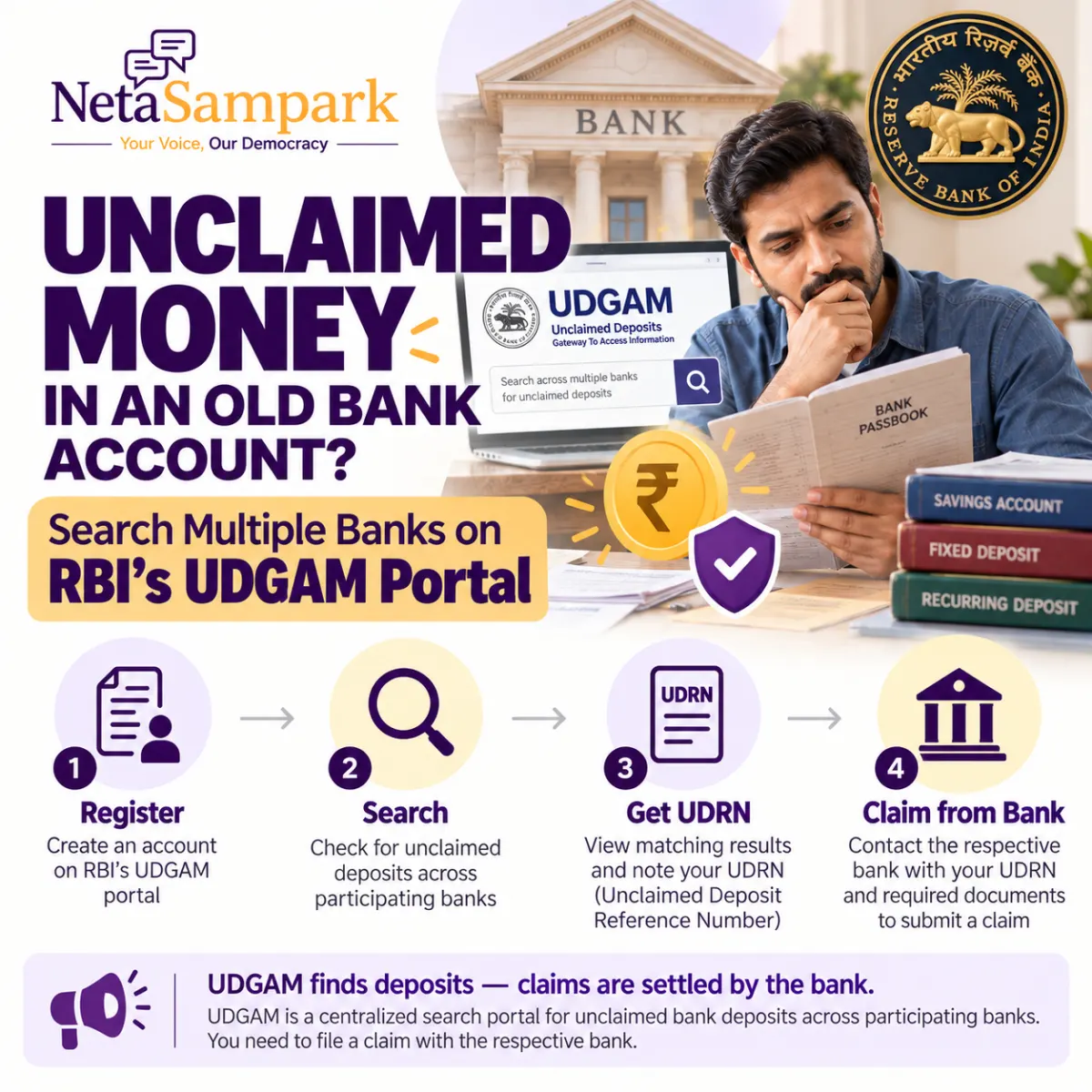
Have you ever closed an old job, moved to another city, forgotten a savings account or lost track of a fixed deposit? There may be money sitting in an old bank account that you or your family have not claimed.
The Reserve Bank of India (RBI) has created an online portal called UDGAM — Unclaimed Deposits–Gateway to Access Information. It allows registered users to search for unclaimed deposits across multiple participating banks from one place.
You do not need to remember every old account number to begin searching. With the account holder’s name, selected bank details and certain identifying information, you can check whether a matching unclaimed deposit appears in the portal.
This guide explains how to use UDGAM, what information you need, how to claim the money and what legal heirs should do if the original account holder has passed away.
1 What is RBI’s UDGAM portal?
UDGAM is a centralised search portal developed by the Reserve Bank of India to help people identify unclaimed bank deposits.
It brings information from participating banks into one searchable interface, instead of requiring people to visit each bank’s website separately.
You can access the portal here:
Open the official RBI UDGAM portal
According to RBI’s published FAQ, the portal’s search facility covered 30 banks as of 4 March 2024, representing approximately 90% of unclaimed deposits by value in the RBI’s Depositor Education and Awareness (DEA) Fund at that time. Check the current bank list on the portal because participation and coverage can change.
What can you find on UDGAM?
Depending on the bank’s available records, the portal can help you identify matching unclaimed deposits or accounts and provide a reference number and information about the bank’s claim process.
It is particularly useful if you:
- Worked in different cities and opened accounts with several banks.
- Changed jobs and stopped using a salary account.
- Forgot about an old savings account or fixed deposit.
- Want to check accounts belonging to a deceased parent, spouse or other family member.
- Need to locate deposits belonging to an eligible business or organisation.
Important: UDGAM does not itself approve or settle your claim. You must approach the respective bank to establish your entitlement and complete the claim process.
2 Why does bank money become unclaimed?
A bank deposit can become unclaimed when the account holder does not operate the account or claim the amount for a prolonged period.
Common examples include:
- A salary account left unused after changing jobs.
- A savings account opened during college and forgotten later.
- A fixed deposit that matured but was never collected or renewed.
- Money in an account belonging to a deceased family member.
- An account opened in another city whose records are no longer readily available.
- A deposit for which the bank cannot reach the customer using the contact details on record.
Under the RBI’s framework, balances in deposit accounts that remain unoperated for 10 years or more, or amounts that remain unclaimed for 10 years or more in the circumstances specified under the DEA Fund Scheme, are transferred to the DEA Fund maintained by the RBI.
This transfer does not mean that the rightful depositor permanently loses the money. Eligible depositors and claimants can approach the bank to recover the amount under the applicable procedure.
3 What information do you need before searching?
For an individual account holder, RBI’s UDGAM FAQ specifies the following search information.
| Information | Why it is useful |
|---|---|
| Account holder’s name | Identifies the person associated with the deposit |
| Bank name | Select one or more participating banks |
| At least one identifying detail | Helps narrow the search to a matching record |
The identifying details accepted for individual searches include:
- Permanent Account Number (PAN).
- Driving licence number.
- Voter ID number.
- Passport number.
- Date of birth.
RBI’s FAQ also explains that an address can be entered in place of the listed identifying details when the required information is unavailable.
You first need to register on UDGAM using your name and mobile number. Follow the current portal instructions to complete registration and login.
For a non-individual account, such as a company or other entity, the search fields differ. These can include the entity’s name, bank, authorised signatory’s name, PAN, Corporate Identification Number (CIN) or date of incorporation.
Use only the official portal and do not share your login credentials or OTP with anyone claiming to help you retrieve the money.
4 Step-by-step: How to search for unclaimed money on UDGAM
Step 1: Open the official portal
Visit udgam.rbi.org.in. Confirm that you are using the official RBI portal, not a third-party website offering to find or release your money for a fee.
Step 2: Register or log in
If you are a first-time user, select the registration option. Enter the requested details, including your name and mobile number, and complete the verification process. Existing users can log in with their registered credentials and follow the portal’s authentication steps.
Step 3: Choose the correct search category
Select the individual search option if you are searching for your own account or an individual’s deposit. If you are searching on behalf of a business or organisation, use the non-individual option.
Step 4: Enter the account holder’s details
Enter the account holder’s name and select one or more banks. You can search multiple participating banks in one session.
Provide at least one of the accepted identifying details, such as PAN, voter ID, driving licence, passport number or date of birth. If you do not have one of these details, check the portal’s current instructions for using an address as an alternative search input.
Step 5: Submit the search
Submit the form and examine the matching results. A successful search may display details such as the account holder’s name, place, bank name and Unclaimed Deposit Reference Number (UDRN).
Check the information carefully. Similar names can produce matches that belong to someone else.
Step 6: Note the UDRN
If you find a possible match, open the relevant result and record the UDRN. This is the Unclaimed Deposit Reference Number assigned by the bank to the unclaimed deposit.
RBI explains that the UDRN is designed to protect account privacy by preventing third parties from identifying the account holder or branch directly from the reference number.
Download or print the search result if the portal offers that option.
Step 7: Open the bank’s claim instructions
The bank name displayed in the result links to information about that bank’s claim or account-reactivation procedure.
Follow those instructions to contact the bank and submit the necessary documents. The bank—not UDGAM—will verify your identity and entitlement and process the claim.
5 How to claim the money after finding a match
Finding a matching deposit is the first step. You must still establish that you are the account holder or an eligible claimant.
The process generally involves the following steps:
- Contact the relevant bank. Use the bank’s official website or the claim instructions linked from the UDGAM result.
- Provide the UDRN and available account details. The bank may request additional information to locate and verify the deposit.
- Submit the claim form and KYC documents. Follow the bank’s prescribed process and document requirements.
- Complete verification. The bank will check your identity, entitlement and any other applicable conditions.
- Receive the amount or reactivate the account, where appropriate. The bank will inform you of the outcome and any further steps.
The exact process may differ between banks and between claims involving living account holders, nominees and legal heirs.
Do not assume that the UDRN alone is sufficient to obtain payment. It is a reference to help the bank identify the record.
What documents might the bank request?
Depending on the circumstances, the bank may ask for:
- Proof of identity and address accepted under its KYC process.
- PAN or other identifying details, where applicable.
- The UDRN or search result.
- Account details or old bank documents, if available.
- A claim form and signature verification.
- Additional documents relevant to a deceased depositor, nominee or legal-heir claim.
The bank’s own current checklist is the one to follow. Do not send original documents by post or hand them to an unauthorised intermediary without confirming the bank’s procedure.
6 What if the account belongs to a deceased family member?
You may be able to claim an unclaimed deposit belonging to a deceased relative, but the procedure depends on the account’s nomination and legal status.
Start by searching for the deceased account holder’s details through UDGAM, where appropriate. If you find a matching result, contact the bank and explain that you are enquiring on behalf of a deceased depositor.
The bank may require some or all of the following, depending on the case:
- Death certificate.
- Identity and address proof of the claimant.
- Nominee details, if a nomination exists.
- Claim form prescribed by the bank.
- Legal-heir or succession-related documents where required.
- Indemnity, affidavit or other supporting documents, depending on the circumstances and bank procedure.
A nominee and a legal heir are not necessarily the same in every legal context. The bank will assess the applicable rules, nomination records and documents before settling the claim.
If several family members have a potential claim or there is a dispute over succession, obtain legal advice before submitting declarations or signing an indemnity.
7 What if UDGAM does not find your account?
A search with no results does not conclusively prove that no unclaimed money exists in your name.
Possible reasons include:
- The bank holding the deposit is not currently included in UDGAM.
- The name or identifying details do not match the bank’s records.
- The deposit has not yet entered the category of unclaimed deposits covered by the portal.
- The account is recorded differently, such as under an earlier name.
- The bank’s records require a separate search or enquiry.
Here is what you can do next.
First, try another search. Check spelling variations, the name recorded when the account was opened and any previous name used by the account holder.
Second, check the participating bank list. If you remember a bank that is not listed, search its official website for its unclaimed-deposit facility.
Third, contact the bank directly. Provide your identity details and any old passbook, fixed-deposit receipt, statement or account information you have.
Fourth, check family records. Old emails, tax documents, salary slips and bank statements may help identify accounts you no longer remember.
Finally, keep a record of the enquiry. If you have a possible claim, retain the acknowledgement or reference number provided by the bank.
8 Is there a deadline to claim money transferred to the RBI’s DEA Fund?
RBI’s published information on the DEA Fund states that there is no specific time limit under the scheme for a depositor or eligible claimant to request a refund of an amount transferred to the fund.
Nevertheless, it is sensible to initiate the claim once you discover a possible deposit. Bank records, KYC requirements and the evidence needed to establish entitlement can make an old claim more complicated.
The bank will assess the claim under the applicable rules and verify the claimant’s identity and entitlement before making payment.
9 What if the bank does not process your claim?
If you have submitted the required documents and the bank has not resolved your claim, begin with the bank’s official grievance-redressal mechanism.
Keep copies of:
- Your claim form and supporting documents.
- The UDRN and bank reference number.
- Acknowledgements and correspondence.
- Any written explanation or rejection issued by the bank.
If the bank rejects your claim or does not respond within 30 days of your complaint, or if you are dissatisfied with its response, you may be eligible to approach the RBI’s Complaint Management System under the Reserve Bank–Integrated Ombudsman Scheme, subject to the scheme’s eligibility conditions.
Official grievance portal: RBI Complaint Management System.
The Ombudsman process is not a substitute for establishing your identity and entitlement. Make sure you have first raised the matter with the bank and retained its response or the details of your complaint.
10 Frequently asked questions
Is RBI’s UDGAM portal free to use?
Yes. UDGAM is an RBI-developed search portal for identifying unclaimed deposits across participating banks. You do not need to pay an agent to search it.
Can I claim the money directly through UDGAM?
No. UDGAM helps you find potential unclaimed deposits and directs you to the relevant bank’s claim instructions. The bank processes the claim.
Do I need my old bank account number?
Not necessarily to begin a UDGAM search. The portal uses the account holder’s name, selected bank details and accepted identifying information to search for matching deposits. The bank may ask for further information during the claim process.
Can I search several banks at once?
Yes. The portal allows users to select one or more participating banks for a search. Check the current list of participating banks on UDGAM.
What is a UDRN?
UDRN stands for Unclaimed Deposit Reference Number. It is a unique reference generated by the bank for an unclaimed deposit transferred to the DEA Fund. Keep it available when approaching the bank about a matching result.
Will the money automatically be transferred to my account when I find it?
No. You must submit a claim to the respective bank and complete its verification process. Payment or account reactivation depends on the bank’s assessment and applicable procedures.
Can I search for a deceased parent’s old account?
You can use available information to look for a matching deposit, but the bank will determine what documents are required from the nominee or legal heir. A successful search does not automatically establish your right to receive the money.
Conclusion: Search today, then claim through the bank
Forgotten bank deposits can remain unclaimed for years because people move cities, change jobs, lose documents or are unaware of accounts held by deceased relatives.
RBI’s UDGAM portal makes it easier to search for such deposits across participating banks from a central location.
The process is straightforward: register, search, identify a possible match, note the UDRN and approach the bank with the required documents. If the portal does not return a result, check the participating-bank list and contact the relevant bank directly.
Start here: RBI UDGAM portal.
Your old bank account may hold money worth recovering. A search is a practical first step.
About NetaSampark
NetaSampark helps citizens understand public services, government initiatives and practical processes through accessible guides.
Explore more resources at NetaSampark.com.