
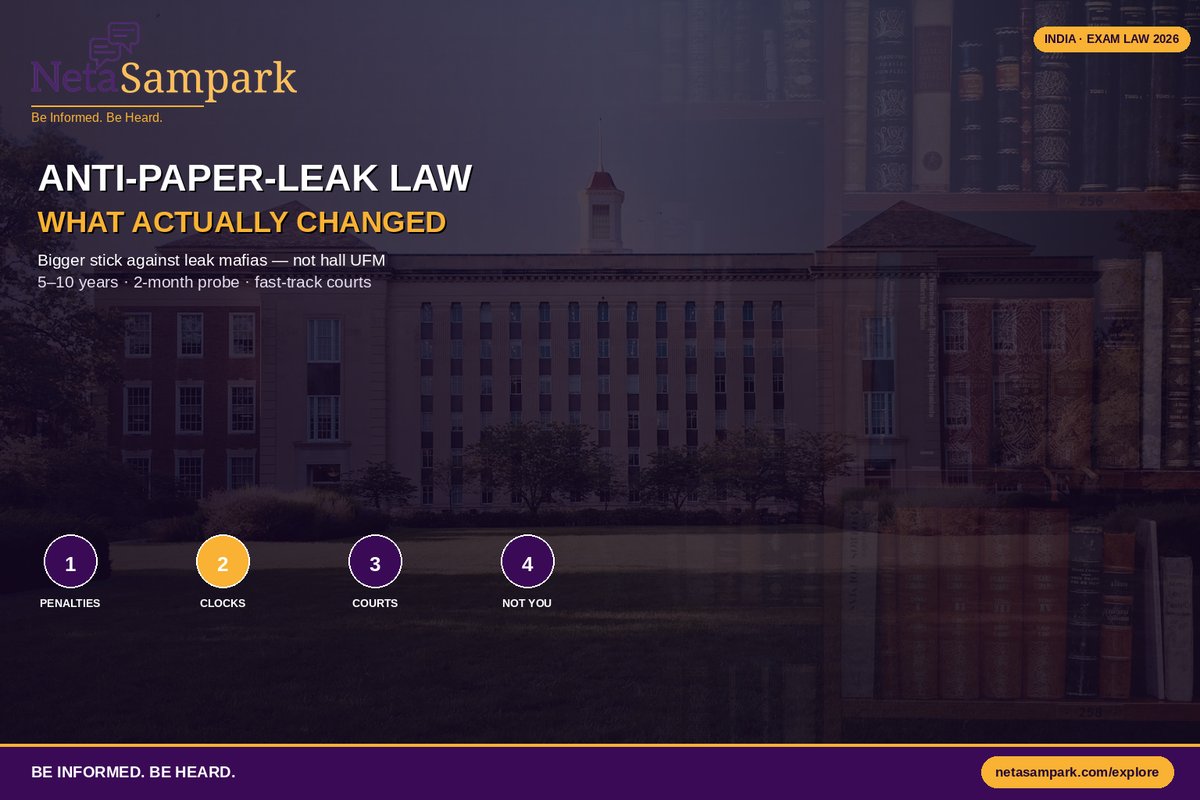
Public Examinations Amendment 2026: What Actually Changed for Students and Parents
Quick take: The Public Examinations (Prevention of Unfair Means) Act, 2024 is about preventing cheating and organised malpractice in public examinations. The 2026 changes and related rules/notices should not be read as “one new punishment for every student who makes a mistake.” The important distinction is between ordinary exam misconduct by a candidate and organised unfair means, paper leaks, impersonation, collusion, or people running a cheating operation.
If you're a student or parent, the practical question is simple: What conduct can get you into trouble, who can be punished, and what should you do if an exam centre accuses you of malpractice?
This is a citizen/student explainer, not legal advice. Always check the latest notification, examination-board rules, and the specific notice issued in your case.
First: what is the Public Examinations law?
The Public Examinations (Prevention of Unfair Means) Act, 2024 was created to prevent unfair means in examinations conducted by specified public examination authorities.
The idea is bigger than catching one student with a chitsheet.
The law targets activities such as:
- leaking question papers
- obtaining examination papers or answers unlawfully
- helping candidates during an examination
- unauthorised access to examination information
- manipulating computer systems or examination technology
- creating fake examination documents
- organised cheating or impersonation
- other prohibited acts connected with conducting public examinations
The law is particularly concerned with organised malpractice and people who facilitate cheating, not merely a nervous student making an innocent mistake.
That distinction matters.
What counts as a “public examination”?Not every test conducted in India automatically falls under the central Act.
The legislation applies to examinations conducted by the public examination authorities covered by the Act and notified framework.
Depending on the examination, the relevant authority may have its own additional rules, instructions and disciplinary procedures.
So don't assume:
“This is an exam, therefore the Public Examinations Act automatically applies.”
Read the examination notification and the instructions printed on your admit card.
The biggest misunderstanding: “One mistake = criminal case”This is where social-media posts can create unnecessary panic.
There are several different layers of consequences.
Layer 1 — Examination-centre action
An invigilator may confiscate prohibited material, stop a candidate from continuing, record an incident, or report suspected unfair means.
Layer 2 — Examination-board disciplinary action
The examination authority may investigate and impose consequences under its own rules.
Depending on the examination, this can include cancellation of a paper, cancellation of the examination, debarment for a period, or other disciplinary action.
Layer 3 — Criminal proceedings
Where the facts amount to an offence under applicable law, the matter can go beyond examination discipline and into the criminal-justice system.
These are not the same process.
A student receiving an unfair-means notice does not automatically mean that a criminal conviction has occurred.
What actually changed in 2026?Be careful with headlines saying:
“New exam law bans students for X years.”
or
“Every cheating case will now mean jail.”
Those headlines can collapse several different legal and examination rules into one sentence.
For a student, the important questions are:
- Which examination authority conducted the exam?
- What exact conduct has been alleged?
- Which rule or section is mentioned in the notice?
- Is this an examination disciplinary proceeding, a police case, or both?
- What is the deadline for your explanation or appeal?
Don't respond to a WhatsApp summary.
Respond to the actual notice.
Student caught with a phone? Don't panic—but don't ignore itSuppose a phone is found with you during an examination.
The correct response is not:
“Everyone uses phones.”
It is also not:
“I'm automatically guilty.”
Instead, ask for the procedure to be followed under the examination rules.
The centre may:
- seize the prohibited item
- record the incident
- obtain your statement
- prepare an unfair-means report
- cancel or withhold the paper/result pending decision
- refer the matter to the examination authority
Your responsibility is to cooperate without signing something you don't understand.
If you are asked to write a statement, read it carefully before signing.
If something is factually wrong, state the correction.
What if the allegation is false?This is where documentation becomes extremely important.
Imagine your answer sheet is flagged because an invigilator claims you possessed unauthorised material.
You believe you did not.
Don't simply send:
“Sir, I didn't cheat.”
Create a factual response.
Your representation should contain:
1. Examination
Name, date, paper, centre and roll number.
2. Allegation
Quote the allegation exactly as written in the notice.
3. Your response
Explain what happened chronologically.
4. Evidence
Mention witnesses, CCTV availability, seating arrangement, confiscation memo, answer-sheet details or other relevant material.
5. Request
Ask for the material relied upon and an opportunity to submit your explanation under the applicable rules.
Keep the tone calm.
The objective is to create a record.
Parents: don't immediately confront the school or centreThe first instinct is often:
“I'll go there and create pressure.”
Usually, that's the wrong move.
Instead:
- Get a copy of the notice.
- Photograph every page.
- Note the deadline.
- Ask which examination rule has been invoked.
- Ask whether the result is being withheld or cancelled.
- Help the student prepare a factual written response.
- Keep proof of submission.
If the matter has become a criminal case, obtain appropriate legal advice rather than trying to negotiate the criminal allegation through a school WhatsApp group.
Paper leak and student cheating are not the same problemThis distinction deserves attention.
A person who organises a paper leak is operating at a very different level from a candidate who violates an examination-centre instruction.
The public-examinations framework is designed in significant part to attack the ecosystem around organised unfair means:
Question paper → leak → intermediary → money → candidate → examination centre
Breaking that chain requires action against people who manufacture, obtain, distribute or facilitate leaked material.
That's why students should be particularly careful about Telegram/WhatsApp groups promising:
“100% confirmed paper”
“Tomorrow's exact questions”
“Pay ₹5,000 for the leaked paper”
Even if the file turns out to be fake, participating in such schemes can create serious complications.
Don't buy leaked papers. Don't forward them. Don't become the middleman.
What about coaching centres and exam contractors?The law is not simply a “student cheating law.”
People or organisations involved in conducting examinations can also face consequences where they engage in prohibited unfair means.
That is important because organised malpractice often requires infrastructure:
- access to examination systems
- question-paper handling
- impersonators
- fake documents
- technology manipulation
- unauthorised communications
- coordinated assistance to candidates
If a student is approached by somebody offering to “manage” an examination result, the safest answer is no.
Keep the message and report it through the appropriate examination authority or law-enforcement channel.
Your admit card is not just an entry ticketStudents often throw the admit card into a drawer after the exam.
Don't.
Keep:
- admit card
- application/registration number
- examination instructions
- fee receipt
- correspondence
- result screenshots
- unfair-means notices
- written explanations
- acknowledgement receipts
Create one digital folder:
Exam → Year → Application / Exam / Result / Notices
If something goes wrong six months later, you'll be very glad you did.
If your result says “withheld”Don't automatically interpret this as:
“I have failed.”
A result can be withheld for several reasons, including verification or disciplinary proceedings.
Read the exact status.
Then find out:
- Who has withheld it?
- Why?
- Under which rule?
- Is there a notice?
- Is a response required?
- What is the deadline?
- Is there an appeal/review mechanism?
Do not miss a deadline while waiting for somebody at the coaching centre to explain it.
What if police contact you?This is the point where the situation is different from an ordinary examination grievance.
If you're told that an FIR has been registered or police are investigating an alleged offence, don't treat it as merely a result problem.
Ask for the basic details you are legally entitled to know and seek appropriate legal assistance.
Students—especially minors—should involve their parent/guardian and, where appropriate, a lawyer.
Don't delete chats or documents because someone says:
“Just clean your phone.”
Preserve relevant material.
Don't fabricate an explanation either.
A simple “don't make it worse” ruleWhen an examination dispute begins:
Don't
- delete messages
- edit screenshots
- manufacture documents
- threaten invigilators
- post accusations against named individuals
- pay a fixer
- sign blank papers
- ignore notices
- rely exclusively on WhatsApp advice
Do
- preserve evidence
- obtain the written allegation
- note deadlines
- respond factually
- keep acknowledgement
- use the examination authority's grievance/appeal process
- get legal help if the matter becomes criminal or legally complex
A five-minute pre-exam check can prevent a surprisingly large number of problems.
Before leaving home
☐ Admit card
☐ Valid ID as specified
☐ Transparent stationery/pouch if required
☐ Permitted calculator or equipment, if applicable
☐ Centre instructions read
☐ Prohibited-item list checked
☐ Phone/watch/electronics arrangement understood
☐ Reporting time confirmed
Don't rely on:
“They allowed it last year.”
The current examination instructions win.
If your phone accidentally enters the centreTell the appropriate examination staff before the examination starts and follow their instructions.
Do not hide it under your desk.
Do not switch it off and hope nobody notices.
Do not attempt to access it.
The safest approach is transparency and compliance with the centre's procedure.
Parents: teach one sentenceBefore an important exam, tell your child:
“If something goes wrong, don't improvise. Tell the invigilator and follow the written procedure.”
That is more useful than a twenty-minute lecture about punishment.
If an entire batch is affectedSuppose 40 students receive similar unfair-means notices.
Don't create 40 contradictory stories.
Create a factual matrix:
StudentExamAllegationNotice dateResponse deadlineEvidenceAPaper 1PhoneDateDateStatementBPaper 1PhoneDateDateSeating planCPaper 1Same allegationDateDateCCTV request
Anonymise personal information when sharing publicly.
A pattern can then be presented to the examination authority in an organised manner.
When civic escalation makes senseNetaSampark should not replace the examination authority's disciplinary process.
If your individual unfair-means case is pending, the first route remains the examination authority and, where necessary, legal remedies.
But if there is a systemic administrative problem—for example:
- an examination centre repeatedly lacks basic facilities
- thousands of candidates face the same technical failure
- an entire district receives incorrect examination information
- a public recruitment examination is repeatedly disrupted
- students cannot obtain responses from the responsible department
then the issue becomes broader than one student's grievance.
Document the pattern first.
Then take the factual brief to the appropriate authority and, where useful, your elected representatives through NetaSampark Representatives.
The representative should help surface an administrative problem—not interfere with an individual criminal investigation or demand that examination rules be bypassed.
The student evidence packKeep this ready if something goes wrong:
☐ Admit card
☐ Registration/application number
☐ Examination instructions
☐ Notice alleging unfair means
☐ Your written explanation
☐ Proof of submission
☐ Relevant emails/SMS
☐ Screenshots with dates
☐ Names/details of relevant officials
☐ Any acknowledgement or diary number
☐ FIR details, if one exists
☐ Lawyer's correspondence, if applicable
Never surrender your only original document without a receipt.
The 10-minute parent response planIf your child calls after an exam saying:
“Something happened at the centre.”
Don't panic.
Minute 1–2
Get the story from the student.
Minute 3
Ask whether they received a written notice.
Minute 4
Photograph everything.
Minute 5
Identify the examination authority.
Minute 6
Identify the exact allegation.
Minute 7
Find the response deadline.
Minute 8
Save all digital evidence.
Minute 9
Prepare a factual timeline.
Minute 10
Decide whether this is an ordinary examination grievance or whether legal advice is needed.
That sequence prevents emotional escalation from destroying useful evidence.
The bigger lessonPublic examinations depend on trust.
Students need confidence that:
the paper is secure → the exam is fair → malpractice is investigated → innocent candidates get a hearing → genuine offenders face consequences.
The law is one part of that system.
Technology, invigilators, examination authorities, police, courts and—most importantly—clear procedures are the other parts.
For students, the safest approach isn't fear.
It's knowing the rules before the exam and knowing the procedure when something goes wrong.
Student checklist: save this
Before exam
☐ Read current instructions
☐ Check prohibited items
☐ Save admit card
☐ Confirm centre and reporting time
During exam
☐ Follow invigilator instructions
☐ Don't use prohibited devices/material
☐ Report accidental issues immediately
If accused
☐ Get written allegation
☐ Note deadline
☐ Preserve evidence
☐ Respond factually
☐ Keep acknowledgement
If police/legal action begins
☐ Inform parent/guardian
☐ Preserve relevant records
☐ Get appropriate legal advice
☐ Don't improvise or destroy evidence
Soft close
An exam should test what you studied—not how well you navigate a crisis.
Know the current rules, keep your documents, and if something goes wrong, build a paper trail instead of a WhatsApp war.
For broader education and public-service follow-up, explore NetaSampark and keep your representatives mapped to the issues that affect your community.
Be informed. Be heard.
Non-partisan civic explainer. Examination rules, notifications and applicable procedures can change; verify the current notice issued by the relevant examination authority before acting. This article is general information, not legal advice.