
Can you complain to the government if the police refuse to register your complaint? What happens when someone alleges custodial violence? Can the National Human Rights Commission (NHRC) take up a case without waiting for a victim to file a complaint?
The NHRC is one of India’s key statutory institutions for protecting and promoting human rights. It can inquire into allegations, seek reports from authorities, summon witnesses in appropriate proceedings and recommend relief or further action.
It also has a mechanism for receiving complaints from citizens and people acting on behalf of victims.
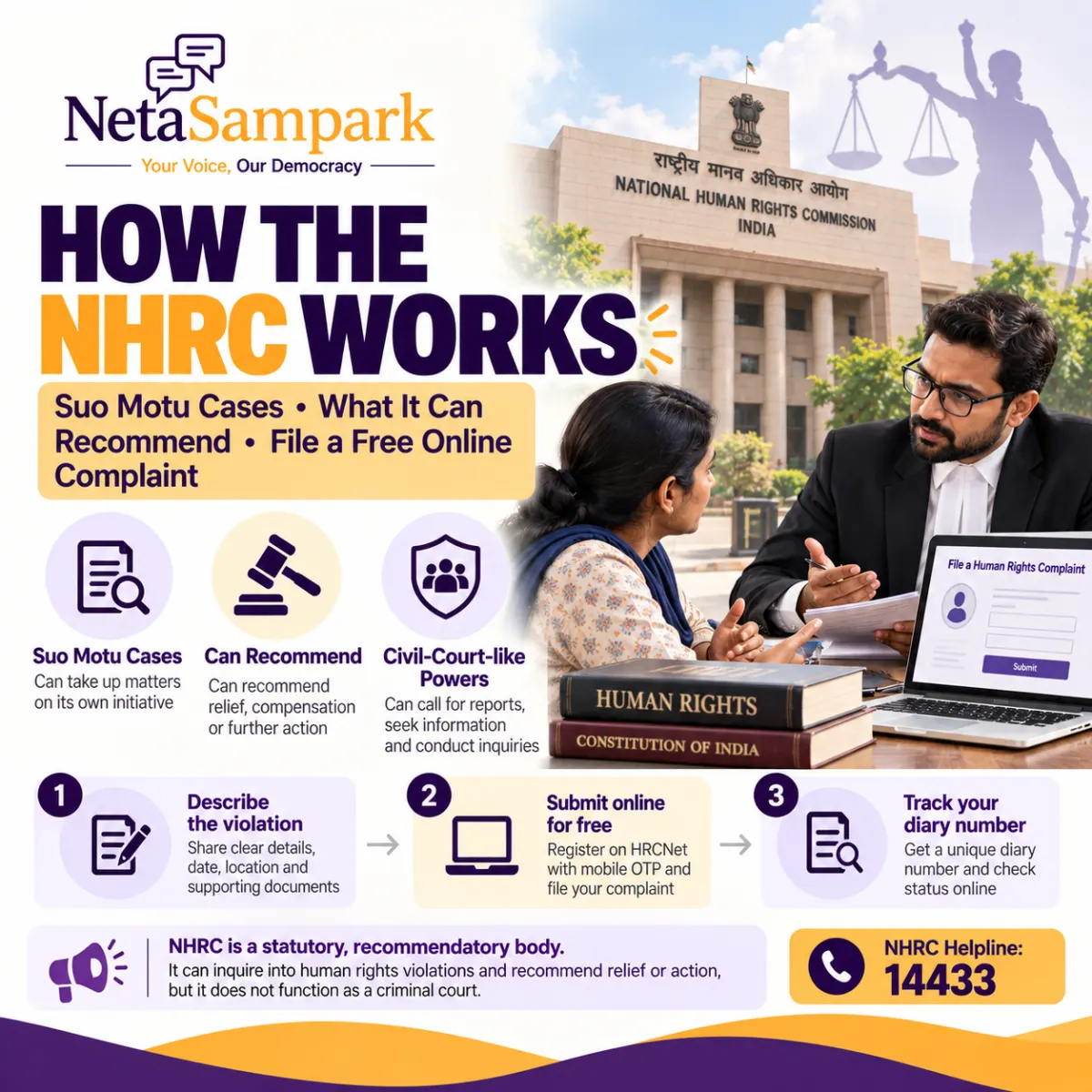
In this guide, we explain how the NHRC works, what suo motu cases mean, what powers the Commission has, what it cannot do, and how to file a complaint online without paying a fee.
1 What is the NHRC?
The National Human Rights Commission of India was established on 12 October 1993 under the Protection of Human Rights Act, 1993.
Its mandate includes protecting and promoting human rights relating to life, liberty, equality and dignity, as recognised by the Constitution and applicable laws.
The Commission examines allegations involving human rights violations and negligence in preventing such violations by public servants. It can also review safeguards for human rights, visit certain detention and care institutions, promote awareness and recommend measures to improve protection.
Official website: National Human Rights Commission of India.
What kinds of cases can the NHRC examine?
The NHRC’s published guidance identifies issues such as:
- Alleged illegal arrest or detention.
- Custodial violence and deaths in custody.
- Police inaction or alleged abuse of authority.
- Alleged atrocities against vulnerable communities.
- Bonded labour and certain forms of exploitation.
- Alleged violations affecting women and children.
- Poor conditions in prisons and certain other institutions.
- Negligence by public servants in preventing human rights violations.
Whether a particular complaint can be entertained depends on the facts, the Commission’s statutory jurisdiction and the applicable restrictions.
The NHRC is not a universal grievance authority for every dispute with a government department or private individual. The complaint should raise a human rights issue that falls within its mandate.
2 What does “suo motu” mean?
Suo motu is a Latin expression meaning “on its own motion.”
In the context of the NHRC, it means the Commission can decide to take up a matter without waiting for a formal complaint from an affected person.
For example, if credible information about a serious alleged human rights violation comes to the Commission’s attention, it may consider initiating proceedings on its own initiative, subject to its legal powers and procedures.
The Commission’s law division handles cases arising from complaints, court directions, official notifications and suo motu cognizance. <Cite refs={["turn682177search11"]}/>
What kinds of incidents might prompt suo motu action?
Depending on the information available and the circumstances, matters that may attract the Commission’s attention include:
- Reports of deaths in police or judicial custody.
- Allegations of serious violence involving public officials.
- Reports of severe abuse or exploitation of vulnerable people.
- Credible reports of large-scale human rights violations.
- Incidents where authorities may have failed to prevent a serious violation.
These are examples, not a guarantee that the NHRC will automatically open a case whenever such an incident is reported.
Does every media report lead to an NHRC case?
No. A report may bring an incident to the Commission’s attention, but whether it takes cognizance depends on the available information, legal jurisdiction and its assessment of the matter.
Suo motu action also does not automatically establish that an allegation is true. The facts may need to be examined and relevant authorities may be asked to respond.
3 What powers does the NHRC have?
The Protection of Human Rights Act gives the Commission several powers to inquire into complaints and recommend appropriate measures.
It can seek reports from authorities
The Commission may ask a central or state government, or a subordinate authority, to provide information or a report within a specified time.
If the requested report is not received within the stipulated time, the Commission may proceed with its inquiry independently, as permitted by law.
It has certain powers of a civil court
While conducting inquiries under the Act, the NHRC has specified civil-court powers. These include:
- Summoning witnesses and examining them on oath.
- Requiring the discovery and production of documents.
- Receiving evidence on affidavits.
- Requisitioning public records or copies from courts and offices.
- Issuing commissions for examining witnesses or documents.
These powers help the Commission gather information and examine allegations. They do not turn it into a regular criminal court.
It can recommend relief or further action
After an inquiry, the Commission may recommend measures such as:
- Payment of interim relief or compensation to the victim or their family.
- Initiation of prosecution or other appropriate action against a public servant, where warranted.
- Further administrative or corrective action.
- Approaching the Supreme Court or a High Court for appropriate directions, orders or writs.
The legal nature of these powers matters: the NHRC is principally a recommendatory body, not a criminal court that independently convicts and sentences people. Its recommendations and the subsequent response of the relevant authority are governed by the Protection of Human Rights Act.
4 What can the NHRC not do?
It is important to understand the limits of the Commission before deciding where to file a complaint.
It does not replace the police or criminal courts
The NHRC can examine alleged human rights violations and recommend action, but it is not a substitute for reporting a crime to the police or pursuing an appropriate court remedy.
If someone faces an immediate threat, violence or unlawful confinement, they should seek urgent assistance from the relevant emergency services and legal authorities rather than waiting for an NHRC complaint to be processed.
It does not decide every personal or civil dispute
A routine property dispute, contractual disagreement or private disagreement will not necessarily fall within the Commission’s jurisdiction merely because one party believes they have been treated unfairly.
The facts must raise an issue that the NHRC is legally empowered to examine.
It has restrictions on older cases
The NHRC ordinarily does not inquire into an alleged human rights violation after one year has elapsed from the date of the act constituting the violation, under Section 36(2) of the Protection of Human Rights Act.
This is an important reason to act promptly. Do not assume that filing a complaint after the one-year period will necessarily be accepted.
It ordinarily does not entertain certain complaints
According to the NHRC’s published FAQ, complaints may not ordinarily be entertained if they are:
- Anonymous or pseudonymous.
- Vague or frivolous.
- Related to events more than one year before the complaint.
- Concerning a matter that is sub judice, or pending before a court.
- Related to service matters.
The Commission may also decline matters outside its statutory jurisdiction or where the applicable legal restrictions prevent it from proceeding. Check the official guidance before submitting your complaint.
5 How to file an NHRC complaint online for free
The official HRCNet portal allows people to submit complaints to the NHRC or an eligible State Human Rights Commission.
Start here: File a complaint on the official HRCNet portal.
There is no fee for filing an NHRC complaint.
Step 1: Open the official complaint form
Visit the HRCNet online complaint page. Select the state in which the incident occurred and choose the commission to which you want to submit the complaint—NHRC or the relevant State Human Rights Commission, as appropriate.
The portal’s current form and instructions should be followed if the interface changes.
Step 2: Verify your mobile number
Enter the requested mobile number and complete the OTP verification process.
Provide a valid email address if requested or available, so that you can receive updates and retain a record of the submission.
Step 3: Enter the complainant’s details
Complete the mandatory fields for the person submitting the complaint. This may be the victim or another person acting on the victim’s behalf.
Enter accurate contact details. Do not provide another person’s private information without a legitimate reason or appropriate authority.
Step 4: Enter the victim’s details
Provide the victim’s details as requested by the form. If you are filing on behalf of someone else, distinguish your own details from those of the person affected.
Where the portal provides a choice about displaying names on the website, read the instructions carefully before making a selection. A display preference should not be treated as a guarantee of absolute confidentiality in every stage of the legal process.
Step 5: Describe the incident clearly
Include the information needed to understand what happened:
- Date and location of the incident.
- What happened, in chronological order.
- Who was affected.
- Names, designations or descriptions of the public servants involved, where known.
- Any complaint already made to the police or other authority.
- The response received, if any.
- The human rights concern you want the Commission to examine.
Keep the account factual and specific. Distinguish what you personally witnessed from what someone else told you.
Step 6: Upload supporting documents if available
The portal allows supporting documents to be uploaded where required, with PDF specified in its instructions.
Relevant evidence may include complaint acknowledgements, medical records, photographs, official correspondence, notices, orders or other records that support the allegations.
Keep your original documents and submit copies unless the relevant authority specifically requires otherwise. Avoid uploading unrelated personal information.
Step 7: Explain the relief or action sought
State what you want the Commission to examine or recommend.
For example, depending on the case, you may ask it to seek a report from the responsible authority, examine allegations of misconduct, consider appropriate relief or recommend corrective action.
Do not demand an outcome as though it is guaranteed. The Commission will determine what action, if any, is appropriate under the law.
Step 8: Preview and submit the complaint
Review the information before submitting it. Correct any errors and ensure that the chronology, names and dates are consistent.
Submit the form using the portal’s final submission option.
Step 9: Save your unique diary number
After successful submission, the portal provides a unique diary number. Save it along with your acknowledgement and any available copy of the complaint.
You can use the diary number to track the complaint’s status through the official portal.
6 How to track an NHRC complaint after filing
Submitting a complaint does not automatically mean that an inquiry has been opened or that relief has been granted.
To check the status:
- Open the official HRCNet portal.
- Select the complaint search or tracking option.
- Enter the requested reference information, including your diary number where applicable.
- Review the available status information.
- Retain any new reference numbers, notices or communications.
The portal also provides features for complaint registration, responses from authorities and status tracking.
If you need help with the complaint process, the NHRC lists its toll-free helpline as 14433. Its facilitation centre also publishes contact numbers for general queries and complaint status.
7 What happens after you file a complaint?
The next steps depend on the nature of the allegations and whether the Commission decides the complaint can be entertained.
A typical process may include:
Initial scrutiny: The complaint is examined to determine whether it falls within the Commission’s jurisdiction and meets the applicable requirements.
Request for information: The NHRC may seek a report or response from the relevant government or authority.
Examination or inquiry: Depending on the case, the Commission may review documents, obtain further information, use its investigation staff or conduct other permitted inquiries.
Decision on further action: The Commission may close a matter, seek additional information or recommend relief or further action, depending on its assessment.
Action-taken response: The relevant government or authority is required to respond to the Commission’s reports or recommendations within the applicable period. The NHRC’s FAQ describes a one-month period for general complaints and three months for complaints relating to the armed forces, subject to the relevant statutory framework and circumstances.
There is no single guaranteed resolution time for every complaint. Keep checking your status and respond promptly if the Commission asks for additional information.
8 Can you file with a State Human Rights Commission instead?
Yes. India has State Human Rights Commissions established under the Protection of Human Rights Act, subject to the applicable provisions.
The HRCNet portal lets complainants select either the NHRC or a State Human Rights Commission from the available options.
When choosing where to file, consider the location and nature of the incident, the commission’s jurisdiction and the current filing instructions. Do not assume that every state has identical procedures or that every commission is available through the portal in the same way.
If you are unsure, check the official NHRC website and the HRCNet portal before submitting.
9 How to write a clear human rights complaint
A complaint is easier to assess when it sets out the facts in a logical order.
You can use this outline when preparing your account:
Subject: Complaint regarding alleged human rights violation at [location]
1. Complainant details: Name and contact details.
2. Victim details: Name and relevant details, where appropriate.
3. Incident: Date, time, place and a chronological account of what happened.
4. Persons or authorities involved: Names, designations or identifying details, if known.
5. Earlier complaints: Any police complaint, departmental representation or court proceeding relating to the incident.
6. Supporting documents: A numbered list of the documents attached.
7. Relief sought: The action or inquiry you are requesting the Commission to consider.
8. Declaration: Confirm that the information provided is accurate to the best of your knowledge.
Avoid exaggeration, abusive language or unsupported allegations. If you do not know a particular detail, state that clearly instead of guessing.
If the incident involves immediate danger, serious injury or an ongoing crime, seek urgent help from the appropriate emergency or law-enforcement authorities as well. The NHRC process should not be treated as a replacement for immediate protection.
10 Frequently asked questions
Is it free to file a complaint with the NHRC?
Yes. The NHRC’s published FAQ confirms that no fee is charged for filing complaints. Use the official portal and be cautious of anyone demanding payment to register your complaint.
Can I file a complaint on behalf of another person?
Yes. The Protection of Human Rights Act permits a petition by a victim or a person acting on the victim’s behalf, subject to the applicable requirements. Provide accurate information and explain your connection to the incident where relevant.
Can the NHRC take action without a complaint?
It may take up a matter on its own initiative, known as suo motu cognizance, where the circumstances and law permit. This is not an automatic response to every news report or allegation.
Can the NHRC punish a police officer?
The Commission can inquire into allegations and recommend prosecution, other appropriate action or relief where warranted. It is not itself a criminal court that independently convicts and sentences the officer.
Can I complain about a case that is already in court?
The NHRC ordinarily does not entertain matters that are sub judice. If related proceedings are pending, obtain legal advice and carefully review the Commission’s current rules before filing.
Is there a deadline to file a human rights complaint?
Section 36(2) of the Protection of Human Rights Act generally restricts the Commission from inquiring into an alleged violation after one year from the date of the act constituting it. If you believe your rights have been violated, seek advice and act promptly.
How do I track my complaint?
Use the complaint search or tracking facility on the HRCNet portal and retain the unique diary number issued after successful submission.
Conclusion: Know the process and keep a record
The NHRC provides a formal route for raising certain human rights concerns, examining allegations and recommending relief or further action.
Its ability to take up matters suo motu can bring serious incidents to its attention even when an affected person has not filed a formal complaint. Its inquiry powers allow it to seek information and examine evidence, while its recommendatory role means that it should not be confused with a criminal court.
If you believe an incident falls within its mandate, use the official HRCNet portal, present a clear account, attach relevant evidence and save the diary number.
Start here: File a human rights complaint online through HRCNet.
About NetaSampark
NetaSampark helps citizens understand public institutions, legal rights and government processes through practical, accessible guides.
Explore more resources at NetaSampark.com.