How India’s Cell Broadcast Disaster Alert Works — and What That Siren Test Means
If your phone suddenly vibrated, made a loud warning sound and displayed an emergency message, it can be startling.
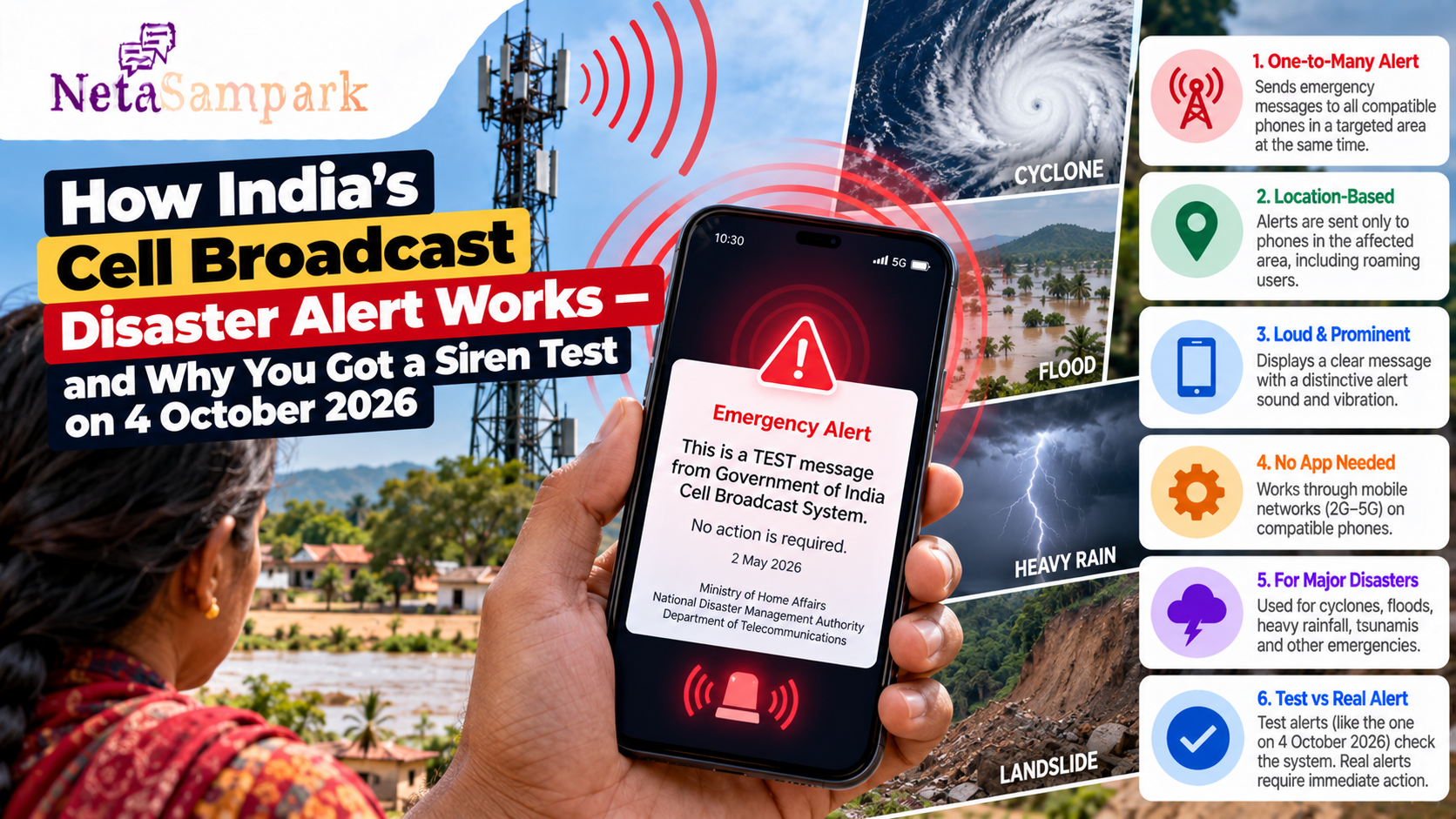
India now has a nationwide Cell Broadcast System (CBS) designed to deliver disaster warnings directly to mobile phones in a defined geographic area. The system was launched in May 2026 by the Department of Telecommunications (DoT), in collaboration with the National Disaster Management Authority (NDMA) and the Ministry of Home Affairs. Press Information Bureau
One important clarification about the 4 October 2026 reference: official sources I could verify document the nationwide Cell Broadcast launch test on 2 May 2026, as well as earlier and continuing system testing. I could not find an official government release confirming a separate nationwide test specifically on 4 October. So if you received a test alert on 4 October, it may have been a regional, operator, device or other controlled test, rather than a newly announced nationwide emergency.
What is Cell Broadcast?
Cell Broadcast is a public-warning technology that allows an authorised agency to send a message to many mobile phones in a defined geographic area at the same time.
It is different from an ordinary SMS.
With SMS:
Sender → individual mobile number → recipient
With Cell Broadcast:
Authorised alert → mobile network cell → compatible phones in that area
The government says India's system can send geo-targeted alerts in near real time and is designed to reach mobile users in the affected area, including people who are roaming. Press Information Bureau
That makes it particularly useful when an emergency develops quickly and authorities need to warn people within seconds rather than relying on people to open an app or check social media.
Who operates India's system?
Several government systems work together.
NDMA
The National Disaster Management Authority operates the Integrated Alert System known as SACHET.
DoT and C-DOT
The Department of Telecommunications oversees the telecom infrastructure, while the Centre for Development of Telematics (C-DOT) developed India's indigenous Cell Broadcast solution.
Warning agencies
The integrated system brings together warning-generating agencies including:
- India Meteorological Department (IMD)
- Central Water Commission (CWC)
- Indian National Centre for Ocean Information Services (INCOIS)
- Defence Geoinformatics Research Establishment (DGRE)
- Forest Survey of India (FSI)
State and Union Territory disaster-management authorities are also part of the alerting chain. Press Information Bureau
How does an alert reach your phone?
The process broadly looks like this:
1. A hazard is detected
For example, a weather or disaster agency detects a potentially dangerous event.
2. An authorised agency prepares the warning
The warning is generated and handled through the CAP-based Integrated Alert System.
3. The affected area is identified
The system can use geographic targeting, including individual mobile cells or clusters of cells. Press Information Bureau
4. The alert is sent through participating mobile networks
Instead of sending individual SMS messages to millions of numbers, the Cell Broadcast system distributes the warning through the mobile network to phones within the targeted area.
5. Your phone displays the warning
A compatible phone can display a prominent notification accompanied by a distinctive sound and vibration.
The government says the system supports 2G through 5G networks, allowing it to cover both urban and rural areas. Press Information Bureau
Why does the phone make such a loud sound?
The unusual sound is deliberate.
An emergency warning is designed to attract your attention even if:
- Your phone is in your pocket.
- You are not looking at the screen.
- You are doing something else on the phone.
- The phone is operating in an area experiencing heavy network traffic.
The system uses priority notifications and distinctive alert tones rather than behaving like an ordinary text message. Press Information Bureau
So a sudden siren-like tone does not automatically mean there is a disaster happening around you.
If the notification explicitly says TEST, it is a test.
If it is a real emergency alert, however, read the message and follow the instructions from the relevant authorities.
Is Cell Broadcast the same as SMS?
No.
| Feature | SMS alert | Cell Broadcast |
|---|---|---|
| Delivery | Individual messages | One-to-many broadcast |
| Targeting | Mobile numbers | Geographic area |
| Phone number required by alert system | Yes | No |
| Speed | Can involve delivery queues | Near real time |
| Suitable for mass emergency warnings | Yes, but limited | Specifically designed for mass warning |
| Alert sound | Normal notification behaviour | Distinct emergency tone |
| Roaming users in affected area | Depends on service | Designed to reach users in target area |
India already had an SMS-based disaster-warning capability through SACHET. Cell Broadcast is an additional mechanism intended to strengthen alerts in situations where speed and mass reach are critical. Press Information Bureau
Does it need an app?
No.
Cell Broadcast is a network-level mechanism. You don't need to download the SACHET app to receive a Cell Broadcast warning.
The government's system is integrated with mobile networks and compatible handsets. Press Information Bureau
This is important because an emergency-warning system should not depend on everyone having installed the same application beforehand.
Does it use your phone number?
Cell Broadcast is designed around geographic targeting rather than sending a separate message to every telephone number.
That means an alert can reach people who are physically inside the affected area even if they are visitors or roaming users.
The government specifically says the system can reach roaming users in the targeted area. Press Information Bureau
What kinds of disasters can trigger an alert?
India's Cell Broadcast system is intended for situations where rapid public warning may be necessary.
Government documents identify hazards including:
- Cyclones
- Tsunamis
- Heavy rainfall
- Lightning
- Flash floods
- Thunderstorms
- Hailstorms
- Avalanches
- Cloudbursts
- Industrial or man-made disasters
- Other emergencies requiring immediate warning
The actual warning depends on the hazard, its location and the assessment of the authorised warning agency. Press Information Bureau
Why was the system tested?
A disaster-warning system cannot simply be switched on for the first time during a disaster.
It has to be tested across:
- Mobile networks
- Different geographic areas
- Different handset models
- Different languages
- Different network technologies
- Alert delivery and display mechanisms
India conducted extensive testing before and around the launch of the system. In April 2026, the government specifically warned citizens that test messages could appear multiple times while the Cell Broadcast infrastructure was being validated. Press Information Bureau
The May 2 nationwide launch also included a test in which mobile phones received emergency messages with a distinctive alert tone. Press Information Bureau
Earlier trials had also been conducted in different parts of India, including testing involving individual telecom operators and states. Press Information Bureau
Why can you receive an alert even if you are only visiting an area?
This is one of the useful features of geographic broadcasting.
Suppose you are travelling through a district affected by a flash flood warning.
You may not live there and may never have registered your phone number with the local disaster authority.
But if your compatible handset is connected to a participating mobile network cell within the targeted area, the broadcast can reach you.
The government says the system is designed to cover both residents and roaming users in the targeted area. Press Information Bureau
What should you do when you receive a real alert?
Don't immediately dismiss it.
Step 1: Read the entire message
Look for:
- Type of hazard
- Affected area
- Time period
- Instructions
- Evacuation information
- Shelter or emergency-contact information
Step 2: Follow the official instruction
If the alert says to evacuate, move to the specified safe location.
If it advises staying indoors, follow that instruction.
If it warns against travelling through a particular area, avoid it.
Step 3: Check additional official sources
Depending on the emergency, check information from:
- NDMA
- State Disaster Management Authority
- District administration
- IMD
- Police
- Fire and emergency services
A Cell Broadcast warning is one part of India's wider emergency communication system.
Step 4: Don't forward an unverified screenshot
A genuine alert can be useful. But a screenshot or forwarded message without context can become misinformation.
Check the original message and official sources before sharing.
What if you received a test alert?
If the message clearly identified itself as a test, you generally did not need to take emergency action.
During the government's earlier testing programme, DoT explicitly told recipients that test messages were part of the planned exercise and required no action. Press Information Bureau
So if the phone suddenly sounded an alarm during a test, the purpose was to check whether the warning system could get your attention—not to indicate an actual disaster.
Can you switch off these alerts?
This needs an important distinction.
During the 2026 launch, the government stated that actual Cell Broadcast emergency alerts are priority notifications and cannot be disabled by users. Press Information Bureau
However, the government also provided instructions during the testing phase for controlling test-alert channels on supported phones:
Settings → Safety and emergency → Wireless emergency alerts → Test alerts
The exact menu can differ by handset manufacturer and operating-system version. Press Information Bureau
So don't assume that switching off a test-alert setting means you have disabled genuine disaster warnings.
What if your phone did not receive the test?
That does not necessarily mean your phone cannot receive future alerts.
Delivery can depend on factors such as:
- Handset compatibility
- Network coverage
- Whether the test channel was enabled
- Mobile network configuration
- Software/device settings
- Whether your phone was inside the targeted geographic area
The government's testing programme specifically used test channels and was intended to validate performance across the mobile network infrastructure. Press Information Bureau
Does Cell Broadcast work when mobile internet is down?
Cell Broadcast is not the same thing as an internet notification or app push message. It uses the cellular network's broadcast capability.
The Indian system is designed for delivery through mobile networks and supports 2G to 5G. Press Information Bureau
However, that should not be interpreted as a guarantee that an alert will work through every possible network outage. If the relevant cellular infrastructure itself is unavailable, no cellular broadcast can reach the handset.
For serious emergencies, continue to rely on other official warning channels as well.
Why India needs more than one warning channel
No single communication method is perfect.
India's Common Alerting Protocol-based Integrated Alert System can distribute warnings through multiple channels, including:
- SMS
- Cell Broadcast
- Television
- Radio
- Internet-based channels
- Coastal sirens
- Other satellite and communication systems
The government describes this as a multi-channel approach to geo-targeted disaster warnings. Press Information Bureau
That matters because a person may not have:
- Internet access
- A smartphone
- A particular app
- Television access
- Electricity
at the exact moment an emergency occurs.
A simple citizen checklist
When your phone suddenly sounds an emergency alarm:
☐ Read the notification
☐ Check whether it says TEST or LIVE/EMERGENCY
☐ Check the affected location
☐ Follow the instructions if it is a genuine warning
☐ Check official disaster-management information
☐ Don't forward unverified screenshots
☐ Keep your phone charged during severe-weather situations
The bigger picture
India's Cell Broadcast System is intended to make disaster warnings faster, more geographically targeted and harder to miss.
The system, developed by C-DOT with DoT and NDMA, is integrated with the SACHET alert platform and is designed to deliver warnings across mobile networks, from 2G to 5G. Press Information Bureau
So the next time your phone suddenly vibrates and emits a loud warning tone, don't assume it is a malfunction.
First read the message.
If it says TEST, it is part of system validation.
If it is a real disaster warning, the sound is doing exactly what the system was designed to do: get your attention quickly enough for you to take protective action.