
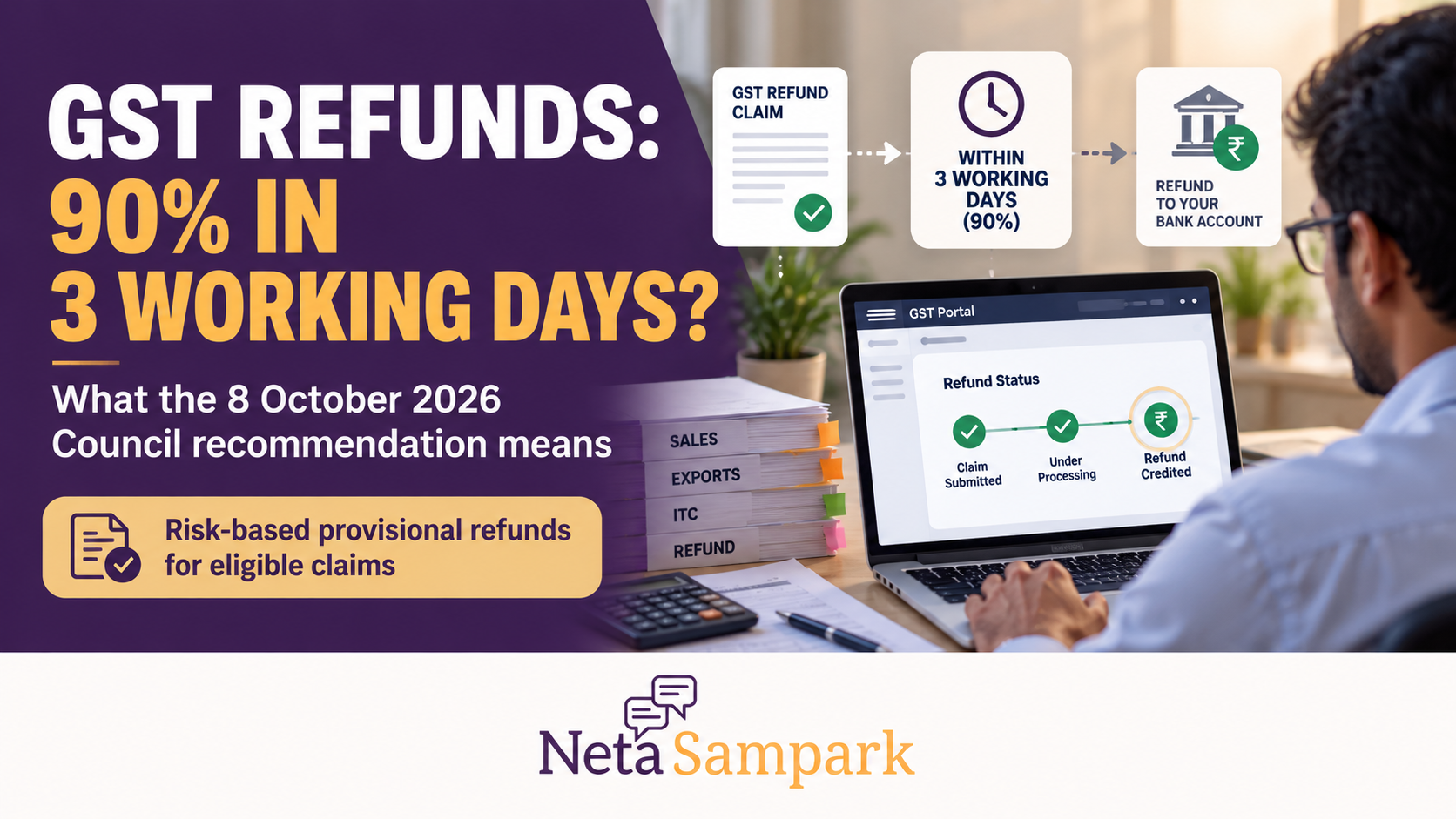
How GST Automated Refunds Will Work After the 8 October 2026 Council Decision: 90% in Three Days?
What did the GST Council announce on 8 October 2026?
For businesses waiting for GST refunds, delays can mean working capital remaining tied up instead of being available for salaries, inventory, suppliers and expansion.
At its 57th meeting on 8 October 2026, the GST Council recommended reforms to make refund processing faster and more automated. The proposals focus on reducing manual intervention, improving the processing of eligible claims and giving businesses greater certainty about the refund process.
According to the Ministry of Finance's official announcement, the proposed changes cover three important areas:
- Automatic sanction of eligible excess balances in the electronic cash ledger.
- Risk-based provisional refunds of 90% for eligible claims relating to zero-rated supplies and the inverted duty structure.
- A shorter acknowledgement timeline, reduced from 15 days to 10 days, with deemed acknowledgement if the proper officer does not issue an acknowledgement or deficiency memo within that period.
These are Council recommendations for changes to the GST framework, not a blanket promise that every taxpayer will receive a refund within three working days. The distinction matters when businesses plan their cash flow.
Source: Ministry of Finance — Recommendations of the 57th GST Council meeting.
1 What does “90% refund in three working days” actually mean?
The headline refers to a proposed faster, system-driven process for eligible refund claims.
The Council's recommendations provide for 90% of the claimed amount to be sanctioned provisionally for qualifying claims relating to zero-rated supplies and the inverted duty structure, based on the system's risk identification and evaluation.
The three-working-day expectation has been described in reporting on the meeting as applying to qualifying claims after acknowledgement. It should not be confused with a universal deadline for every stage of the refund process.
Consider a simple example.
| Refund claim | Illustrative amount |
|---|---|
| Eligible refund claimed | ₹5,00,000 |
| 90% provisional amount | ₹4,50,000 |
| Remaining 10% | ₹50,000 |
If a claim qualifies for the proposed 90% provisional refund, ₹4.5 lakh could be sanctioned provisionally, subject to the applicable conditions and system assessment. The remaining ₹50,000 would be dealt with through the applicable process for final determination.
This is an illustration, not a guarantee that a particular application will be approved or paid within three days.
Remember: Sanctioning a refund and the money being credited to a bank account are related but distinct steps. Businesses should check the applicable rules and the status shown on the GST portal.
2 Which types of GST refunds are covered?
The recommendations distinguish between different kinds of refunds rather than treating all claims identically.
A. Refund of excess electronic cash ledger balance
The electronic cash ledger records money deposited by a taxpayer for GST payments.
Under the proposed first phase, a refund claim for the full eligible excess balance in this ledger would be sanctioned automatically by the system without officer intervention.
For a business that has deposited more cash than it needs for its GST liabilities, this could reduce the effort involved in recovering the excess amount.
However, the facility concerns an eligible excess cash balance. It does not mean that all accumulated input tax credit becomes automatically refundable.
B. Refunds relating to zero-rated supplies
Zero-rated supplies primarily include exports and qualifying supplies to Special Economic Zone units or developers, subject to the applicable GST provisions.
Businesses making eligible zero-rated supplies may accumulate input tax credit or otherwise qualify for refunds under the law.
The Council recommended a risk-based system for provisionally sanctioning 90% of eligible refund claims in this category.
The proposed second phase would go further by providing for automated acknowledgement and sanction of the full eligible refund for qualifying zero-rated claims, after adjustment of pending dues, where applicable.
C. Refunds under the inverted duty structure
An inverted duty structure arises when the GST rate on inputs is higher than the GST rate on output supplies, potentially resulting in accumulated input tax credit.
Eligible businesses may claim refunds subject to the statutory rules and restrictions.
The Council recommended including qualifying inverted-duty-structure claims in the risk-based provisional refund process.
The proposed automation does not eliminate the underlying eligibility conditions. A claim must still qualify under the applicable GST provisions.
3 How will the proposed automated refund process work?
The recommendations point towards a process in which the GST system handles more routine work and officers focus on claims requiring closer examination.
Step 1: File the refund application
The taxpayer submits the relevant refund application, generally in FORM GST RFD-01, along with the required information.
The Council recommended making the application more system-readable and reducing the requirement to upload scanned documents for specified zero-rated and inverted-duty-structure claims.
Step 2: Acknowledgement or deficiency memo
The acknowledgement or deficiency-memo timeline is proposed to be reduced from 15 days to 10 days.
If the proper officer does not issue either within 10 days of the application, the system would provide deemed acknowledgement under the recommended framework.
This is important because acknowledgement helps move an application to the next stage of processing.
Step 3: System-based risk assessment
For eligible zero-rated and inverted-duty-structure claims, the system would identify and evaluate risk.
The risk assessment determines whether the claim qualifies for provisional processing under the proposed framework. It does not mean that every claim will automatically pass.
Step 4: Provisional sanction of 90%
For qualifying claims, 90% of the claimed amount would be sanctioned provisionally without officer intervention under the recommended first phase.
Claims that do not qualify for this route may require further examination under the applicable process.
Step 5: Final determination and payment
The balance amount is dealt with through the relevant final-refund process. In the proposed second phase, qualifying zero-rated claims would receive automated full sanction after due system verification and adjustment of pending dues, where applicable.
The actual payment timeline will depend on the applicable rules, implementation and individual claim circumstances.
4 What is the difference between the first and second phases?
The Council's recommendations describe a phased approach.
| Feature | Proposed Phase 1 | Proposed Phase 2 |
|---|---|---|
| Excess cash ledger balance | Full eligible refund sanctioned automatically | — |
| Zero-rated supplies | 90% provisional sanction for qualifying claims | Automated acknowledgement and full sanction for qualifying claims |
| Inverted duty structure | 90% provisional sanction for qualifying claims | The stated full-sanction automation specifically concerns zero-rated claims |
| Officer involvement | Reduced for qualifying automated claims | Further reduced for qualifying claims handled by the system |
Phase 2 is not a promise of automatic full refunds for every category of GST claim. The official recommendation specifically identifies zero-rated supplies for the full-refund automation described in that phase.
The precise operational dates and detailed procedures should be confirmed through subsequent notifications, rule amendments and GST portal advisories.
5 Who stands to benefit?
The proposed changes could be particularly relevant to:
- Exporters: Businesses that regularly claim refunds on eligible zero-rated supplies.
- Manufacturers: Businesses affected by an inverted duty structure and accumulated eligible input tax credit.
- Small and medium enterprises: Firms for which delayed refunds can create working-capital pressure.
- Businesses with excess cash ledger balances: Taxpayers seeking to recover eligible surplus deposits.
- Finance and tax teams: Professionals who manage refund applications, reconciliations and follow-ups.
The practical benefit will vary by claim type, eligibility, risk assessment and implementation.
A company with a straightforward, low-risk claim may have a different experience from one whose records contain mismatches or whose claim requires detailed examination.
6 What should businesses do now?
Even with greater automation, accurate filings and consistent records will remain important.
Here is a practical checklist for finance teams and business owners.
- Reconcile sales, purchase records and GST returns.
- Verify the input tax credit reflected in the relevant GST records.
- Review the basis and calculation of the refund claim.
- Ensure bank account details on the GST portal are correct.
- Keep export documents, shipping bills and other supporting records where applicable.
- Review any outstanding tax dues or unresolved refund-related issues.
- Monitor acknowledgement, deficiency notices and application status.
- Keep the refund application reference and related correspondence.
- Confirm the effective date of the new process before relying on it for cash-flow forecasts.
Businesses should not stop maintaining supporting records simply because the proposed system aims to reduce document uploads. The underlying eligibility and verification requirements remain important.
7 What if a refund is delayed or the system flags a claim?
Automation is intended to make routine processing faster, not to remove every possible exception.
If a refund does not progress as expected:
- Check the application status on the official GST portal.
- Review whether an acknowledgement or deficiency memo has been issued.
- Respond to any deficiency or clarification request within the prescribed time.
- Reconcile the relevant figures and supporting records.
- Use the applicable GST grievance or departmental channel if a portal issue or unexplained delay persists.
Do not assume that every delay is a system error. The reason may relate to incomplete information, eligibility, risk assessment or another issue under the applicable procedure.
Official portal: GST Portal.
8 Does the Council decision mean the system is already operational?
This is an important question for businesses planning their October 2026 cash flows.
The 8 October announcement describes recommendations for changes to the CGST Act, rules and refund-processing procedures. A Council recommendation should not automatically be treated as proof that every associated system feature is live.
Businesses should check the relevant notifications, amendments and GST portal advisories before relying on the new procedure for a particular application.
Until the applicable changes take effect, taxpayers should continue to follow the refund procedure currently applicable to their claim.
Frequently asked questions
Will every GST refund be paid within three working days?
No. The three-working-day expectation relates to qualifying claims under the proposed risk-based process after acknowledgement. It is not a universal guarantee for all GST refunds or all stages of payment.
Does 90% mean that the government is reducing the refund amount?
No. The 90% figure refers to the amount proposed to be sanctioned provisionally for qualifying claims. The remaining portion is handled through the applicable final-refund process.
Are exporters eligible for the proposed automated refunds?
Eligible zero-rated supply claims, including qualifying export-related refunds, are covered by the recommendations. The claim must satisfy the relevant statutory conditions and system-based risk assessment.
Can a business claim an automatic refund of all its input tax credit?
No. The automatic refund of excess electronic cash ledger balances is different from a refund of accumulated input tax credit. ITC refunds remain subject to the applicable eligibility rules and restrictions.
What happens if the system identifies a claim as higher risk?
The claim may not qualify for provisional automated sanction and could require further examination under the applicable procedure.
Where can I check official updates?
Use the GST Portal and the Ministry of Finance's official announcement. Check subsequent notifications and advisories for effective dates and operational details.
Conclusion: Faster refunds could improve business cash flow, but eligibility still matters
The GST Council's 8 October 2026 recommendations point towards a more automated and risk-based refund process.
For eligible businesses, the proposed 90% provisional sanction could help release working capital sooner. Automatic sanction of excess cash ledger balances and shorter acknowledgement timelines could also reduce routine administrative friction.
But the headline needs context: 90% is a proposed provisional refund for qualifying claims, not a guaranteed payment of every claim within three working days.
For businesses, the best preparation is to keep GST returns reconciled, refund calculations accurate and supporting records ready, while following official notifications for implementation details.
This article is for general information and citizen awareness. It is not tax or legal advice. The final procedure will depend on the applicable law, notifications and GST portal implementation.