
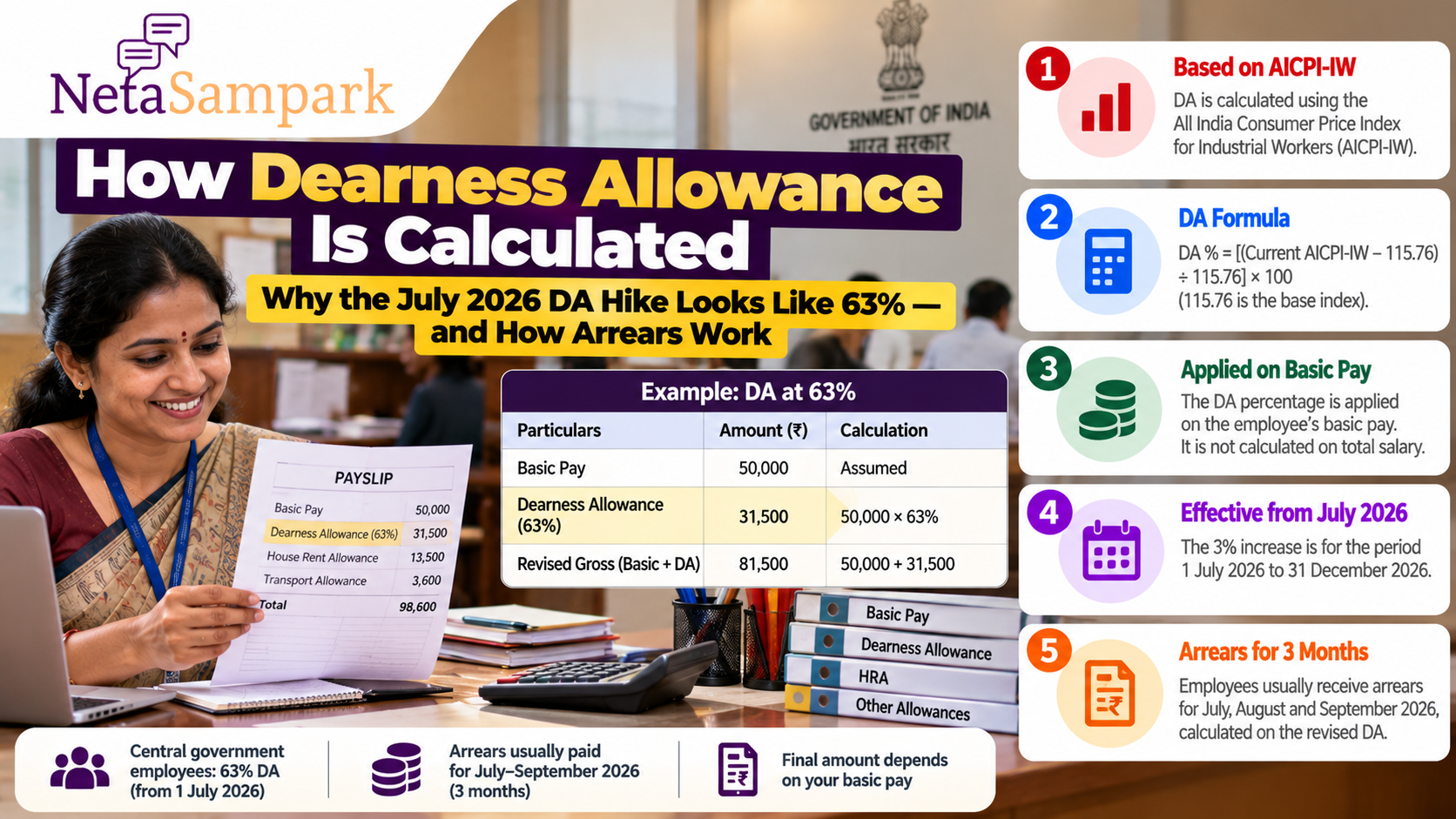
How Dearness Allowance Is Calculated: Why the July 2026 DA Hike Looks Like 63% — and How Arrears Work
For Central Government employees, Dearness Allowance (DA) is not simply decided by adding a fixed percentage to salaries. It is linked to inflation data measured through the All-India Consumer Price Index for Industrial Workers (AICPI-IW) and follows the formula adopted under the 7th Central Pay Commission.
The DA rate currently stands at 60% of Basic Pay, following the 2% increase approved with effect from January 1, 2026. Press Information Bureau
For the July 2026 revision, the January–June 2026 CPI-IW figures point to a calculated DA of about 63.77%, which is why a 63% DA rate is being discussed. However, the important distinction is that a calculated rate is not the same as the final government-notified rate.
Why DA Is Revised Twice a Year
DA for Central Government employees is revised twice a year:
- January 1
- July 1
The calculation is based on inflation data released by the Labour Bureau. Because the CPI-IW figures for the relevant months are released with a time lag, the Government's formal DA order can come later.
This creates an important situation: the revised rate can become effective from July 1 even if the official approval and payment happen months later.
That difference is what creates DA arrears.
What Is AICPI-IW?
AICPI-IW stands for All-India Consumer Price Index for Industrial Workers.
It is compiled and published by the Labour Bureau under the Ministry of Labour & Employment. The current CPI-IW series uses 2016 as the base year = 100. The Labour Bureau's July 2026 index, for example, was 153.2. Labour Bureau
The index tracks changes in the prices of goods and services relevant to industrial-worker households.
When the index rises over time, the inflation-linked DA calculation also rises.
How the 7th CPC DA Formula Works
The 7th CPC calculation uses a 12-month average of CPI-IW along with the linking factor used to connect the current index series with the earlier 2001-base series.
In simplified form, the formula is:
DA % = [((12-month average CPI-IW × 2.88) − 261.42) ÷ 261.42] × 100
The resulting percentage is taken to the applicable whole-number rate for DA calculation. The linking factor 2.88 connects the 2016-base CPI-IW series with the older 2001-base series, while 261.42 is the reference value used in the 7th CPC formula. CSSMitra
An important correction about the “115.76” figure
You may see older articles showing a formula involving 115.76.
That is associated with an older DA calculation framework based directly on the 2001=100 CPI-IW series. It should not be casually substituted into the current 7th CPC calculation using the 2016-base CPI-IW data.
For today's Central Government DA calculation, the 7th CPC linkage is the relevant framework.
Why the July 2026 DA Works Out Around 63%
For the July 2026 revision, the relevant CPI-IW window is January to June 2026.
The published figures were:
| Month | CPI-IW |
|---|---|
| January 2026 | 148.6 |
| February 2026 | 148.5 |
| March 2026 | 149.1 |
| April 2026 | 149.9 |
| May 2026 | 150.8 |
| June 2026 | 151.9 |
The six-month data is combined with the preceding six months to form the required 12-month average.
The resulting average is about 148.65. Applying the 7th CPC formula produces a calculated DA level of roughly 63.77%. staffcorner.in
That is why the July 2026 increase is generally being described as a move from:
60% → 63%
The actual percentage payable, however, must come through the Government's formal DA order.
What Changed From the Previous DA Rate?
The January 2026 revision increased DA from 58% to 60% of Basic Pay, effective January 1, 2026. The Cabinet said the increase was based on the accepted 7th CPC formula. Press Information Bureau
If the July 2026 rate is notified at 63%, the increase would therefore be:
63% − 60% = 3 percentage points
That does not mean an employee's entire salary rises by 3%.
DA is calculated on Basic Pay, not on total gross salary.
Example: Basic Pay of ₹50,000
Suppose an employee has Basic Pay of ₹50,000.
At 60% DA:
₹50,000 × 60% = ₹30,000
At 63% DA:
₹50,000 × 63% = ₹31,500
So the increase is:
₹31,500 − ₹30,000 = ₹1,500 per month
This ₹1,500 is the additional DA resulting from a three-percentage-point increase.
It is not a 3% increase in the employee's entire gross salary.
What Happens to HRA and Other Allowances?
DA is only one component of salary.
An employee's salary may include:
- Basic Pay
- Dearness Allowance
- House Rent Allowance (HRA)
- Transport Allowance
- Special or other applicable allowances
- Deductions such as NPS, CGHS, income tax and others
Therefore, the increase in DA should not automatically be treated as the increase in take-home pay.
Some other benefits or allowances can have their own rules linked to DA or Basic Pay, so the effect depends on the employee's pay level and applicable service rules.
How DA Arrears Work
This is where the July 2026 revision becomes particularly important.
Suppose the Government eventually notifies:
DA = 63% with effect from July 1, 2026
but the revised amount is actually reflected in payroll only later.
The employee remains entitled to the difference for the period beginning July 1, subject to the terms of the Government's order.
For an employee with ₹50,000 Basic Pay:
Existing DA at 60%
₹50,000 × 60% = ₹30,000
Revised DA at 63%
₹50,000 × 63% = ₹31,500
Monthly difference
₹1,500
If three months — July, August and September — are paid later, the basic DA difference would be:
₹1,500 × 3 = ₹4,500
So the arrears are not a separate bonus. They represent the difference between the old and revised DA rates for the period for which the revised rate is made effective.
Your Arrears May Not Be Exactly the Example
The ₹4,500 example assumes:
- Basic Pay remains ₹50,000
- DA moves from 60% to 63%
- Three complete months qualify
- There are no changes affecting the calculation
An employee with Basic Pay of ₹35,400 would have a different figure.
For example:
3% of ₹35,400 = ₹1,062 per month
For three months:
₹1,062 × 3 = ₹3,186
The actual payroll calculation should therefore be made using the Basic Pay applicable in each month, not simply the employee's current gross salary.
What If You Joined, Retired or Were on Leave During This Period?
Arrears can become more complicated when an employee:
- joined government service during the period;
- retired during the period;
- was transferred between departments;
- had a change in Basic Pay;
- had a promotion or MACP-related pay revision;
- was on leave;
- was under suspension or otherwise covered by special pay rules.
In such cases, the eligible period and Basic Pay for each month should be checked against the relevant service and payroll records.
DA Arrears Are Different From Salary Arrears
This distinction is useful when checking a payslip.
Salary arrears can arise because of a delayed promotion, pay revision or other correction.
DA arrears specifically represent the difference created by applying a revised DA rate retrospectively from its effective date.
Your payslip may therefore show a separate arrears line or a corresponding adjustment depending on the payroll system.
What About Pensioners?
Pensioners receive Dearness Relief (DR) rather than DA.
The principle is broadly similar: DR is linked to the inflation-based revision and is applied to the pension as governed by the applicable rules.
The April 2026 Cabinet decision covered both DA for Central Government employees and DR for pensioners. Press Information Bureau
Therefore, pensioners should look for the applicable DR order, rather than treating employee DA and pensioner DR as exactly the same payroll component.
One More Important Update: July 2026 CPI-IW Is for the Next Cycle
There is a potential source of confusion in current DA stories.
The Labour Bureau has already released the July 2026 CPI-IW figure of 153.2. Labour Bureau
That July figure is not what determines the July 2026 DA revision.
Instead, it becomes part of the CPI-IW data used for the next DA revision, effective January 1, 2027.
In other words:
January–June 2026 data → July 2026 DA cycle
July–December 2026 data → January 2027 DA cycle
This is why a July 2026 CPI-IW figure can simultaneously be published while employees are still waiting for the formal July 2026 DA order.
July 2026 vs January 2027: Don't Mix Them Up
The distinction can be summarised like this:
| DA cycle | CPI-IW data used | Effective date |
|---|---|---|
| January 2026 | Previous 12-month cycle | 1 January 2026 |
| July 2026 | Data through June 2026 | 1 July 2026 |
| January 2027 | Data through December 2026 | 1 January 2027 |
The July 2026 CPI-IW of 153.2 therefore belongs to the January 2027 calculation cycle, not the July 2026 calculation. Labour Bureau
What Employees Should Check on Their Payslip
When the July 2026 DA order is implemented, check:
- Basic Pay used for the calculation.
- Previous DA percentage.
- Revised DA percentage.
- Effective date of the revision.
- Monthly DA difference.
- Number of months of arrears.
- Total DA arrears credited.
- Applicable deductions from the arrears.
- Whether any related allowance has also changed under applicable rules.
- Whether the revised DA rate matches the official Government order.
Do not rely solely on WhatsApp messages or unofficial “DA calculators” when checking your final entitlement.
Bottom Line
The July 2026 DA story is easier to understand once three things are separated:
First: DA is linked to the AICPI-IW inflation index and the 7th CPC formula.
Second: The January–June 2026 data produces a calculated level of roughly 63.77%, which is why 63% is being discussed for the July 2026 revision. staffcorner.in
Third: if the revised rate is officially made effective from July 1, 2026 but implemented later, the difference between the old and revised DA for eligible months becomes arrears.
The latest Labour Bureau data also shows that July 2026 CPI-IW has risen to 153.2, but that figure belongs to the calculation cycle for the January 2027 DA revision. Labour Bureau
The key rule for employees is simple: calculated DA, officially notified DA and actual payroll credit are three different stages. Check the final Department of Expenditure order before treating any percentage circulating online as confirmed.