
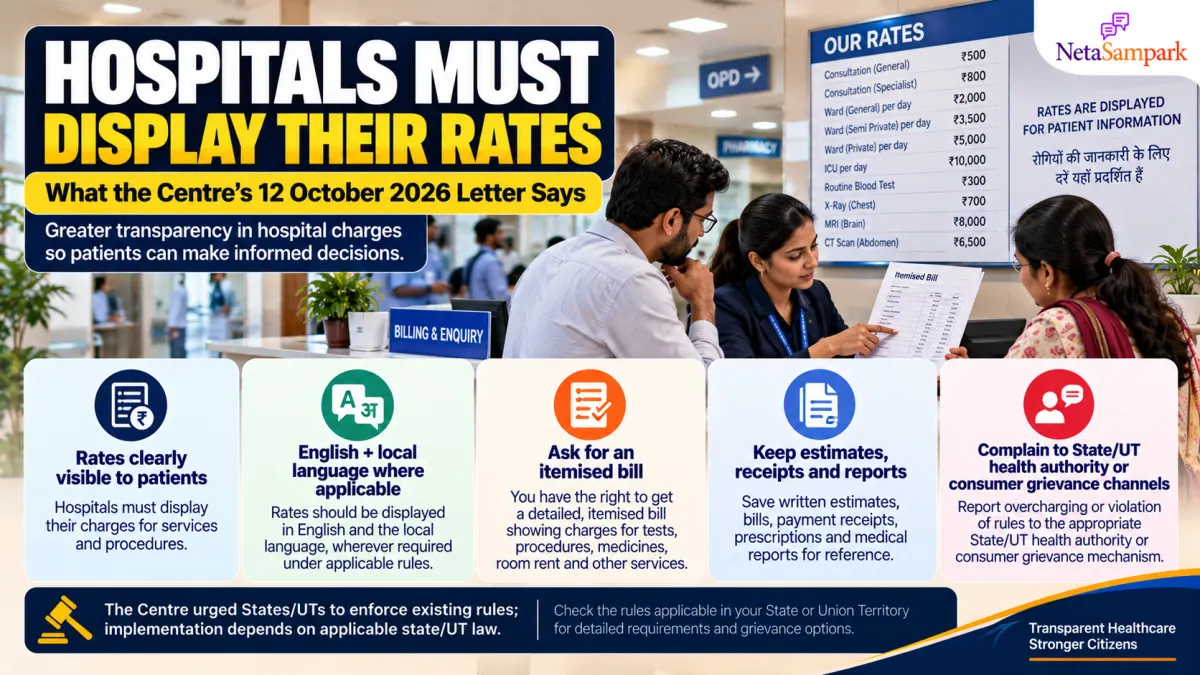
Have you ever received a hospital bill that was much higher than you expected? Patients and their families often struggle to understand consultation fees, room charges, diagnostic costs, medicines and procedure expenses.
On 12 October 2026, the Union Ministry of Health and Family Welfare urged all States and Union Territories to ensure that hospitals and other clinical establishments prominently display their service rates. The initiative aims to help patients understand treatment costs, make informed decisions and reduce disputes over medical bills.
The important point is that the Centre's letter calls for better implementation of existing rules. It does not introduce one uniform price list for every hospital in India. The applicable requirements depend on the laws and regulations governing the establishment in that State or Union Territory.
Official announcement: Press Information Bureau — Centre urges States/UTs to ensure prominent display of healthcare service rates.
What does the Centre's letter dated 12 October 2026 say?
Union Health Secretary Punya Salila Srivastava wrote to the Chief Secretaries of States and Union Territories, asking them to review compliance with applicable regulations and take steps to ensure that healthcare charges are clearly visible and accessible to patients and their attendants.
The letter refers to the Clinical Establishments (Registration and Regulation) Act, 2010, and the Clinical Establishments (Central Government) Rules, 2012.
Under the central framework, clinical establishments in jurisdictions where the Act applies are required to display the rates charged for services and facilities at a conspicuous place, in English and the local language.
The Centre also asked States and Union Territories to encourage transparent display of package rates, wherever applicable, for international patients visiting India on Medical or Ayush Visas.
Key points at a glance
| Issue | What patients should know |
|---|---|
| Rate display | Applicable rules require covered establishments to display charges prominently |
| Languages | English and the local language, where required by the applicable rules |
| Services covered | Rates for services and facilities provided by the establishment |
| One national price list? | No. The letter does not set one uniform price for every hospital |
| Who enforces the rules? | Relevant State and Union Territory authorities |
| Main objective | Greater transparency and fewer billing disputes |
Source: Ministry of Health and Family Welfare announcement, 12 October 2026.
Does this rule apply to every hospital in India?
The principle of transparent healthcare pricing is being reinforced nationally, but the legal framework differs across jurisdictions.
The Clinical Establishments Act, 2010, has been adopted in several States and Union Territories. Other States and Union Territories regulate healthcare establishments under their own laws, some of which also contain requirements for displaying charges.
Therefore, patients should check the rules applicable where the hospital is located.
For details, visit the official Clinical Establishments portal, which provides information about the Act, State rules and relevant authorities.
What rates should you look for at a hospital?
Before undergoing a planned procedure or admission, ask the hospital for its applicable rate list and a written estimate.
Depending on the services offered, useful charges to check include:
- Outpatient consultation fees.
- Room rent and nursing charges.
- Intensive care unit (ICU) charges.
- Laboratory tests and diagnostic imaging.
- Procedure, surgery and operation theatre charges.
- Anaesthesia and specialist fees.
- Medicines and medical consumables.
- Registration, admission and other applicable service charges.
A displayed rate is not necessarily the final cost of a complete treatment. The total bill can vary according to the procedures performed, medicines used, complications, duration of admission and other clinical requirements.
Ask the hospital to explain what is included in a quoted package and which items may be charged separately.
What are your rights when you receive a hospital bill?
Clear pricing helps patients ask informed questions. If you believe a bill is incorrect, you can request an explanation and supporting documents.
1. Ask for an itemised bill
Request a bill that separates the major charges instead of relying only on a single total.
Check the dates, quantities, service descriptions, room category, medicines and diagnostic tests.
2. Compare charges with the estimate
For planned treatment, compare the final bill with the written estimate and any package terms provided before admission.
If the amount differs, ask the billing department to identify the additional services or changes that account for the difference.
An estimate may change when clinical circumstances change, so a difference alone does not prove overcharging.
3. Ask for clarification about unfamiliar charges
If you see an unfamiliar fee, duplicate entry or service you do not recognise, request a written explanation.
Ask for supporting records where appropriate, such as diagnostic reports, prescriptions or the relevant treatment details.
4. Keep your documents
Preserve copies of:
- The initial estimate and package details.
- Itemised bills and payment receipts.
- Prescriptions and diagnostic reports.
- Discharge summary.
- Written communication with the hospital.
- Insurance approval and settlement documents, if applicable.
These records can help establish what was quoted, what treatment was provided and what amount was charged.
5. Raise concerns without delaying urgent care
If treatment is urgent, do not delay emergency medical attention while trying to resolve a billing disagreement. Preserve the records and pursue the complaint through the appropriate channel afterwards.
How to complain about hospital overcharging
If the hospital cannot satisfactorily explain a charge, follow these steps.
Step 1: Complain to the hospital
Write to the billing department or the hospital's designated grievance officer.
Identify the disputed charge, explain why you believe it is incorrect and attach relevant documents. Request a written response and a corrected bill or refund if justified.
Keep an acknowledgement or email record.
Step 2: Contact the State or Union Territory health authority
If the issue involves failure to display required rates, possible non-compliance with registration conditions or other regulatory concerns, contact the authority responsible for regulating clinical establishments in that jurisdiction.
The official Clinical Establishments website provides information about State and Union Territory rules and authorities.
For complaints involving establishments covered by the central Act, you can also review the official grievance information. Financial and regulatory complaints are handled by the relevant State authority.
Step 3: Use the National Consumer Helpline
For a billing dispute or possible unfair trade practice, you can approach the Department of Consumer Affairs' National Consumer Helpline.
- Call: 1915
- Alternative number: 1800-11-4000
- Online: consumerhelpline.gov.in
- WhatsApp: 88000 1915
The helpline operates from 8 AM to 8 PM, except on national holidays, according to its official contact page.
The National Consumer Helpline can help facilitate grievance redressal. It is not a substitute for a court or consumer commission where formal adjudication or compensation is sought.
Step 4: Consider a consumer commission if necessary
If the dispute remains unresolved, you may consider filing a consumer complaint through the appropriate consumer commission, subject to the applicable law and facts of your case.
For guidance on consumer protection and complaint procedures, visit the Department of Consumer Affairs.
What if your dispute involves health insurance?
A disagreement with a hospital and a disagreement with an insurer may require different complaint routes.
If the hospital bill is disputed, first request an explanation from the hospital. If the insurer has rejected a claim, deducted an amount or delayed settlement, complain to the insurer's grievance redressal officer.
If the insurance grievance remains unresolved, consult the Insurance Regulatory and Development Authority of India (IRDAI) for the applicable grievance process and escalation options.
Keep the policy, pre-authorisation, claim decision, final bill and insurer correspondence together.
A simple checklist before paying your hospital bill
Use this checklist when reviewing a non-emergency hospital bill.
- Ask for the applicable rate list and treatment estimate.
- Check the room category and number of days charged.
- Review medicines, tests and procedures listed on the bill.
- Ask about unfamiliar, duplicated or unexpected charges.
- Compare the final bill with the estimate and package terms.
- Request an itemised bill and preserve payment receipts.
- Submit a written complaint if a disputed charge is not explained.
Official links for patients
| Purpose | Official resource |
|---|---|
| Read the Centre's 12 October 2026 announcement | Press Information Bureau |
| Check Clinical Establishments rules and State information | Clinical Establishments portal |
| Review the Clinical Establishments grievance policy | Official grievance information |
| Complain about a consumer billing dispute | National Consumer Helpline |
| Find insurance grievance information | IRDAI |
Final takeaway
The Centre's letter dated 12 October 2026 reinforces the need for hospitals and other covered clinical establishments to display their service rates clearly under the rules applicable to them.
For patients, the practical steps are straightforward: check the rate list, request a written estimate, review the itemised bill and keep your documents. If a charge appears incorrect or the required rates are not displayed, complain first to the hospital and then approach the appropriate State authority or consumer grievance channel.
Transparent pricing does not mean every treatment has one fixed cost. It means patients should have access to the information needed to understand charges, ask questions and seek redress when something appears wrong.