
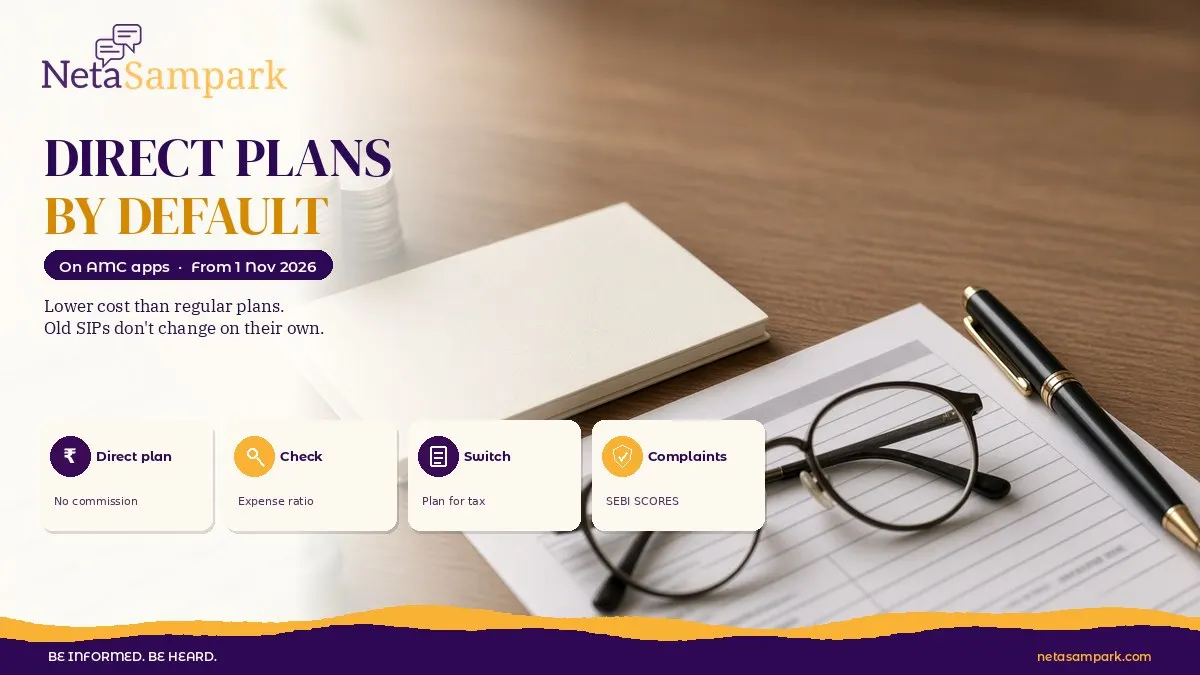
From 1 November 2026, mutual fund company (AMC) websites and apps show the direct plan by default, as per SEBI. You can still pick a regular plan, but you'll see its higher expense ratio first. Your existing regular plans and SIPs don't change automatically. Switching means selling and buying again, so tax and exit load can apply.
Updated 3 November 2026
Quick facts
| Item | Details |
|---|---|
| Official portal | SEBI investor website and sebi.gov.in |
| Helpline | SEBI toll-free 1800 22 7575 or 1800 266 7575 |
| Fee | No fee to choose a direct plan; regular plans carry a distributor commission inside the expense ratio |
| Deadline | Default change applies from 1 November 2026; no action deadline for investors |
| Documents | PAN, KYC-compliant status, bank account; folio number for switching |
| Where it applies | AMC websites and AMC apps (not broker or distributor platforms) |
| Complaints | SCORES after first complaining to the AMC |
What exactly changed on 1 November 2026?
Every mutual fund scheme in India has two versions: a direct plan and a regular plan. Same fund manager, same portfolio, same stocks. The only difference is cost. A regular plan pays a commission to the distributor who sold it to you, and that commission comes out of your returns through a higher expense ratio.
Until now, when you bought from an AMC's own app, you'd often have to hunt for the "direct" option. From 1 November 2026, SEBI wants the direct plan to show up first by default when you invest through an AMC's own website or app. SEBI Chairman Tuhin Kanta Pandey spoke about this in late October 2026.
If you still want a regular plan (say, because you want your distributor's advice), you can pick it. But the platform has to show you the higher expense ratio before you confirm.
Does this change my existing SIPs?
No. As per reports in October 2026 quoting SEBI, existing investments in regular plans are not converted automatically. Your running SIPs carry on in whatever plan you started them in.
What does change: your Consolidated Account Statement (CAS) has to show the commission paid to the distributor on regular-plan SIP transactions. So you'll be able to see in rupees what you've been paying.
How much does a regular plan really cost me?
Distributor trail commission typically falls in these ranges, as per industry data reported in October 2026:
| Fund type | Typical trail commission per year |
|---|---|
| Equity funds | 0.50% to 1.17% |
| ELSS (tax saver) | 0.70% to 1.00% |
| Hybrid funds | 0.50% to 0.80% |
| Debt funds | 0.20% to 0.50% |
That doesn't sound like much. But over a long time, it compounds. Here's a simple example:
• You invest ₹10,000 a month for 15 years
• If you earn 12% a year (direct), you'd end with about ₹50.46 lakh
• If you earn 11% a year (regular, with 1% going to commission), you'd end with about ₹45.89 lakh
• Gap: about ₹4.57 lakh
These are illustration numbers, not a promise of returns. Real returns go up and down. But the cost gap is real and it adds up every single year.
Is a regular plan ever worth it?
Yes, sometimes. If you're new, don't want to research funds, and have a good distributor who actually helps you (picks funds that suit your goal, stops you from panic selling in a crash, does your paperwork), that advice has value.
The question to ask yourself: am I getting advice worth 0.5% to 1% of my money every year? If your distributor just sold you a fund and never called again, probably not.
Another option is a SEBI-registered investment adviser (RIA). They charge you a fee directly and you invest in direct plans. Check any adviser's registration on sebi.gov.in before paying.
How do I switch from a regular plan to a direct plan?
1. Find your folio and plan. Check your CAS from CAMS or KFintech, or your AMC app.
2. Check the exit load. Many equity funds charge 1% if you sell within 1 year of buying. Each SIP instalment has its own date.
3. Check the tax. Switching is a redemption from regular and a purchase in direct. Tax applies on gains.
4. Check lock-ins. ELSS units can't be switched within 3 years of each instalment.
5. Stop the regular SIP and start a new SIP in the direct plan on the AMC website or app.
6. Switch old units in parts if the tax hit is big. You can move only units that are past the exit-load period, or keep gains within the tax-free limit each year.
What tax will I pay when I switch?
For equity mutual funds, under the rates in force since the Budget of July 2024:
• Held more than 12 months: long-term capital gains taxed at 12.5% on gains above ₹1.25 lakh a year
• Held 12 months or less: short-term gains taxed at 20%
Debt fund rules are different and depend on when you bought. Talk to a tax professional if the amounts are large.
A smart move many people use: switch old units in a planned way so the yearly long-term gain stays under ₹1.25 lakh. That way switching costs little or nothing in tax.
What about investing through a broker or distributor app?
The default change is for AMC websites and apps. If you invest through a stockbroker's app, a fintech platform or a bank, those platforms set their own screens. Many fintech apps already show only direct plans. Bank relationship managers and distributors usually sell regular plans, because that's how they earn. Neither is wrong, but you should know which one you're buying. Look for the word "Direct" or "Regular" in the full scheme name on your statement.
What should I check before investing through an AMC app now?
☐ The plan name says "Direct" (check the fund name carefully) ☐ Compare the expense ratio of direct vs regular, shown on the screen ☐ Check exit load and lock-in period ☐ Your KYC status is "validated" ☐ Bank mandate for SIP is set up correctly ☐ Nominee is added
What if something goes wrong?
• If a regular plan was chosen without your consent, complain to the AMC first. Their contact is on the AMC website
• If there's no reply within 21 days or you're unhappy, file a complaint on SCORES
• You can also use the Online Dispute Resolution (ODR) portal linked from SEBI's site
• Never share OTPs or passwords with anyone claiming to "help you switch"
Our explainer on how CPGRAMS grievance filing works is useful if you're new to official complaint routes. And if you want your MP to raise investor issues, find them on NetaSampark.
Final reminder
The direct default is a nudge, not a rule forcing anyone to switch. Look at your CAS, see what commission you're paying, and decide if the advice is worth it. If you switch, plan around exit load and tax. Don't rush to sell everything in one go.
Frequently asked questions
What changed for mutual funds from 1 November 2026?
AMC websites and apps show direct plans by default. Regular plans are still available with a clear expense ratio disclosure.
Will my regular plan SIP become a direct plan automatically?
No. Existing regular holdings and SIPs stay as they are.
What is the difference between direct and regular mutual fund plans?
Same fund and portfolio. A regular plan has a higher expense ratio because it pays distributor commission.
Is switching from regular to direct taxable?
Yes. It's treated as selling and buying, so capital gains tax and exit load can apply.
Where do I complain about a mutual fund problem?
First to the AMC. If unresolved, on SEBI's SCORES portal.
Sources
• Securities and Exchange Board of India