
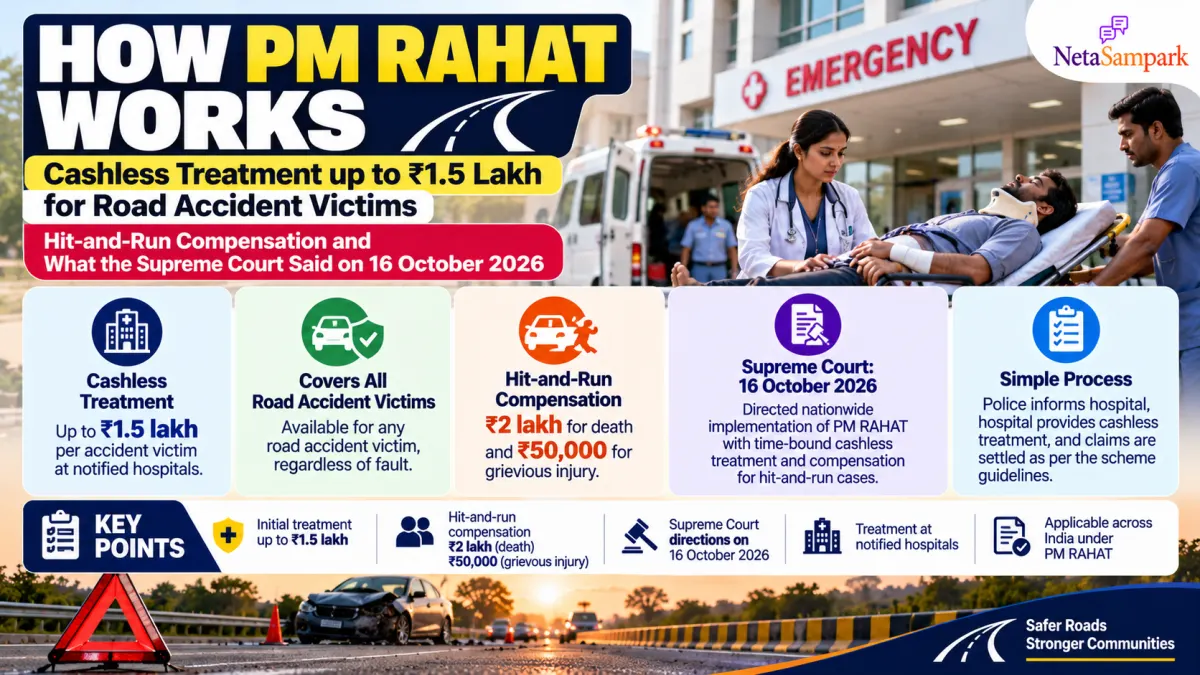
How PM RAHAT Works: ₹1.5 Lakh Cashless Treatment, Hit-and-Run Compensation and the Supreme Court’s October 2026 Directions
A road accident can leave a family facing an emergency hospital bill before it has time to contact an insurer or arrange money. The Government of India’s PM RAHAT scheme aims to reduce this barrier by providing cashless treatment to eligible road accident victims.
The scheme provides treatment cover of up to ₹1.5 lakh per victim for a maximum of seven days from the date of the accident. It applies to accidents involving motor vehicles on any category of road, subject to the scheme’s eligibility and verification procedures.
The Supreme Court has also issued directions concerning road accident care, accident records and compensation. Understanding the difference between medical treatment support and compensation claims is important.
What is the PM RAHAT scheme?
PM RAHAT stands for Prime Minister – Road Accident Victims’ Hospitalisation and Assured Treatment. It was launched in February 2026 to help accident victims receive timely medical care, including during the critical first hour after an injury.
The scheme operates under the legal framework of Section 162 of the Motor Vehicles Act, 1988. It uses digital systems to coordinate accident reporting, police verification, hospital treatment and payment claims.
Key benefits at a glance
| Feature | What it means |
|---|---|
| Maximum treatment cover | Up to ₹1.5 lakh per victim |
| Treatment period | Up to seven days from the accident date |
| Road coverage | Any category of road |
| Accident eligibility | Accidents involving motor vehicles, subject to scheme rules |
| Insurance status | Treatment cover is designed to apply irrespective of the offending vehicle’s insurance status |
| Emergency assistance | Call 112 for ambulance assistance and details of the nearest designated hospital |
The ₹1.5 lakh limit is a treatment-cover ceiling, not a cash payment made directly to the victim. Treatment is provided through designated hospitals under the scheme’s procedures.
How does PM RAHAT work after an accident?
The process is designed to connect emergency response, police verification and hospital treatment.
Step 1: Call 112 for emergency help
If a road accident occurs, call 112 to seek emergency assistance and ambulance support. A Good Samaritan or another person at the scene can also seek help.
Do not delay emergency medical care while trying to establish insurance details or scheme eligibility.
Step 2: Reach a designated hospital
The victim should be taken to a hospital designated under the scheme. The emergency response system can help identify an appropriate hospital.
Step 3: Police verification
The police record and verify the accident through the relevant digital system. The scheme relies on coordination between police, hospitals and the authorities responsible for processing treatment claims.
Step 4: Cashless treatment
Eligible treatment is covered up to ₹1.5 lakh per victim, subject to the seven-day limit and applicable scheme rules. The amount is not an unrestricted reimbursement for every medical expense.
Step 5: Hospital claim processing
Hospitals submit claims through the designated digital system. The scheme uses the electronic Detailed Accident Report (e-DAR) platform and the National Health Authority’s Transaction Management System (TMS 2.0) to support accident verification and payment processing.
What if the accident involves a hit-and-run vehicle?
A hit-and-run accident occurs when the vehicle responsible for the accident cannot be identified or traced in the circumstances covered by the law.
Two different forms of assistance must be distinguished:
- PM RAHAT: Provides eligible victims with cashless medical treatment.
- Hit-and-run compensation: Provides financial compensation under the separate statutory compensation framework.
Under the Scheme for Compensation to Victims of Hit and Run Motor Accidents, 2022, the prescribed compensation amounts are:
| Type of harm | Compensation |
|---|---|
| Death | ₹2 lakh |
| Grievous injury | ₹50,000 |
These are compensation amounts, not additional PM RAHAT treatment limits. A person should not assume that the two benefits are automatically paid together; the applicable eligibility and claim procedures must be followed.
For guidance, contact the local police and district authorities handling motor accident compensation claims.
What did the Supreme Court say in October 2026?
There have been important Supreme Court directions concerning road accident protection, but it is necessary to distinguish the different proceedings.
1. Directions concerning accident records and PM RAHAT
In proceedings concerning suspected fraudulent motor accident compensation claims, the Supreme Court directed authorities to improve the sharing of accident and insurance information across digital systems, including VAHAN, SARATHI, e-DAR and the Insurance Information Bureau.
The directions also extend to hit-and-run cases and PM RAHAT, with the objective of improving coordination and enabling accident alerts to reach insurers. The Court called for action within a specified time and compliance reporting.
These measures are intended to strengthen accident verification and reduce delays and fraudulent claims.
2. The order dated 16 October 2026 concerned a separate interim-relief scheme
A separate Supreme Court proceeding on 16 October 2026 concerned the Compensation to Victims (Interim Relief) Scheme, 2026, framed under Section 164A of the Motor Vehicles Act.
The Court directed the Union Government to publicise that scheme and sought clarification on whether it covers accidents involving uninsured vehicles. The issue arose because the scheme appeared to be limited to cases involving insured vehicles.
This is distinct from PM RAHAT, which provides cashless medical treatment. The 16 October directions should therefore not be described as a new PM RAHAT compensation award or as a fresh order establishing the scheme nationwide.
The practical takeaway is that medical treatment support and interim or final accident compensation are separate legal issues. Victims and families may need to check the rules for each applicable benefit.
What should accident victims and families do?
Keep these steps in mind after an accident:
- Call 112 for emergency assistance.
- Prioritise medical care; do not delay treatment to collect documents.
- Ask the hospital whether it is designated under PM RAHAT.
- Cooperate with the police so the accident can be recorded and verified.
- Keep copies of medical records, discharge summaries, police documents and expense records.
- For hit-and-run cases, ask the police or district authorities how to apply for compensation under the applicable scheme.
- If cashless treatment is refused or delayed, ask the hospital for the reason and contact the relevant State Health Agency or district authorities for grievance guidance.
Official sources and further information
For verified information, refer to these government and judicial sources:
- Press Information Bureau: Government launches PM RAHAT
- Press Information Bureau: PM RAHAT implementation status
- Ministry of Road Transport and Highways
- Supreme Court of India
The bottom line
PM RAHAT is intended to ensure that an eligible road accident victim can receive cashless treatment of up to ₹1.5 lakh for up to seven days, without waiting for insurance arrangements to be resolved.
Hit-and-run compensation follows a separate process, while the Supreme Court’s October 2026 directions address broader questions of accident verification and interim relief. Knowing which scheme applies can help victims and their families seek the right assistance at a difficult time.