
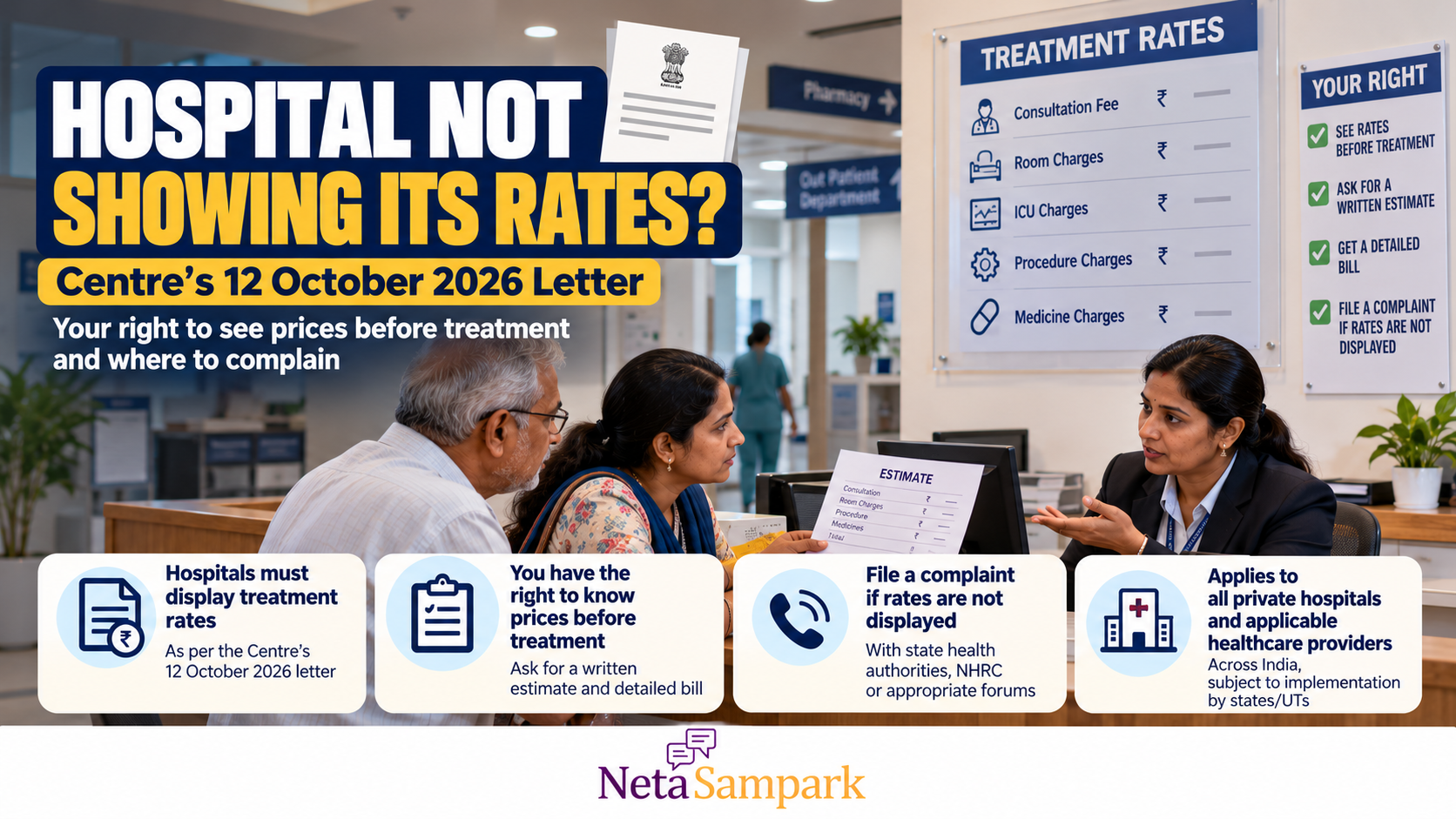
Hospital Not Showing Its Rates? The Centre’s 12 October 2026 Letter, Your Right to See Prices Before Treatment and Where to Complain
A hospital bill should not come as a surprise. Patients and their families need to know what a consultation, diagnostic test, hospital room or proposed procedure is likely to cost before agreeing to treatment. Yet finding a clear rate list or obtaining a written estimate can sometimes be difficult.
On 12 October 2026, the Union Ministry of Health and Family Welfare urged all States and Union Territories to ensure that hospitals and other clinical establishments prominently display their service charges. The Union Health Secretary wrote to the Chief Secretaries of States and UTs, asking them to review compliance with applicable rules and take appropriate action.
The move is intended to help patients make informed healthcare decisions, plan expenses and avoid disputes over bills. But what does it mean for you if a hospital refuses to show its rates? Which charges should you ask about, and where can you complain?
Here is a practical guide based on the Centre’s announcement and the existing patient-rights framework.
1 What did the Centre announce on 12 October 2026?
The Ministry of Health and Family Welfare called on States and UTs to ensure effective implementation of the rules governing the display of healthcare service charges.
According to the Ministry’s announcement, hospitals and other clinical establishments must display the rates for the services they provide and the facilities they offer prominently, wherever the applicable regulatory framework requires it.
In States and UTs covered by the Clinical Establishments (Registration and Regulation) Act, 2010, the applicable rules require the rates to be displayed in a conspicuous place in both the local language and English.
For States and UTs governed by other regulatory frameworks, the relevant State or UT rules determine the applicable requirements.
The Centre also urged States to facilitate transparent display of package rates for international patients visiting India on Medical and Ayush Visas, wherever applicable.
Important: The 12 October communication is a direction to States and UTs to strengthen implementation of existing requirements. It should not be interpreted as a single, newly introduced nationwide price list that makes every hospital charge the same amount.
Read the official announcement here: Press Information Bureau — Centre urges States/UTs to ensure prominent display of healthcare service rates.
2 Do you have a right to know treatment costs before agreeing?
Yes. The Ministry of Health and Family Welfare’s Charter of Patients’ Rights recognises patients’ right to information about their treatment and its expected cost.
The Charter states that patients and their designated caretakers should receive factual information about the expected cost of treatment. The hospital management should communicate this information in writing, including information about additional costs that may arise if the patient’s condition changes.
The Charter also addresses the right to information about the rates charged for services and facilities, access to patient records and a detailed, itemised bill.
You can read the official Charter of Patients’ Rights.
The Charter has been shared with States and UTs for adoption and implementation. The precise enforceable requirements and complaint mechanisms depend on the applicable State or UT framework.
What should you ask the hospital to show you?
Before planned treatment, ask for the relevant rate list and a written estimate covering the proposed treatment.
Depending on your case, the estimate should clarify:
- Consultation charges: Initial consultation, specialist consultation and follow-up visits.
- Room and bed charges: General ward, private room, ICU or other accommodation, including the applicable billing unit.
- Doctor and procedure fees: Surgeon’s fee, anaesthetist’s fee, procedure charges and other professional fees.
- Diagnostic tests: Blood tests, scans, X-rays and other investigations likely to be required.
- Medicines and consumables: Expected medication costs, surgical supplies and disposable items.
- Additional charges: Nursing, equipment, monitoring, registration and other applicable fees.
- Package inclusions and exclusions: What is covered by a quoted package and what could be billed separately.
Not every treatment will involve all these items. Ask the hospital to identify the charges relevant to your proposed care.
3 Does displaying rates mean the final bill cannot change?
No. A displayed rate list and a written estimate help you understand likely expenses, but they do not necessarily guarantee the final bill.
The final cost can depend on the treatment actually required, the length of admission, investigations, medicines, complications and changes in the patient’s condition.
For planned treatment, ask the hospital to distinguish between:
- The quoted package price, if there is one.
- Items included in that package.
- Items that will be charged separately.
- Circumstances that could increase the estimate.
- How the hospital will communicate significant changes in expected costs.
If the doctor recommends an additional procedure or investigation, ask why it is needed and what it is expected to cost, where the clinical circumstances allow.
In an emergency, do not delay urgently needed medical care merely to obtain a complete estimate. Ask for cost information as soon as it is practical and safe to do so.
4 What should you do if the hospital refuses to show its rates?
Start by making a clear, documented request. You do not have to begin with a formal legal complaint.
Step 1: Ask the billing desk or reception
Request the rate list for the specific service, room category, investigation or procedure you need.
If the list is not displayed, ask where it can be inspected or whether a copy is available.
Step 2: Ask for a written estimate
If you are planning an admission or procedure, request a written estimate from the billing department or hospital administration.
Ask for a breakdown rather than only a single total. If the hospital cannot provide a final amount, ask it to identify the estimated range and explain what could change it.
Step 3: Contact the hospital’s grievance officer
If staff continue to refuse, submit a written complaint to the hospital administrator, patient-relations department or designated grievance redressal officer.
Include the date, department, service requested and what happened. Ask for the complaint to be acknowledged and for the applicable rate-display requirements to be followed.
Step 4: Preserve your evidence
Keep copies of:
- Your written request and the hospital’s response.
- Photographs of the relevant reception, billing area or rate board, where taking photographs is permitted.
- Estimates, bills, payment receipts and discharge summaries.
- Relevant emails, messages and complaint acknowledgement numbers.
Avoid photographing other patients or their medical information. Do not put another patient’s private details into a public complaint.
Step 5: Escalate to the appropriate authority
If the hospital does not resolve the issue, approach the relevant State or UT health department, district registering authority or clinical-establishment regulator, as applicable.
The correct authority depends on where the hospital is located and which law governs its registration and regulation.
5 Where can you complain about a hospital that does not display its rates?
There is no single complaint route that applies identically to every hospital in India. Use the channel that matches the nature of your complaint.
Option A: State or UT health department
This is a practical starting point for complaints about a hospital’s failure to display rates or provide required pricing information.
Visit your State or UT health department’s official website and look for the clinical-establishments registration authority, hospital-regulation section or public grievance mechanism.
For example, if you are in Karnataka, begin with the Karnataka Department of Health and Family Welfare. Ask which district or State authority handles complaints about the hospital’s registration and compliance with applicable rate-display requirements.
Option B: District registering authority under the Clinical Establishments Act
The Clinical Establishments (Registration and Regulation) Act, 2010 applies in participating States and UTs. The official Ministry portal lists the jurisdictions covered by the Act.
Where it applies, the district registering authority is a relevant point of contact for a complaint about a clinical establishment’s compliance.
Check the official Clinical Establishments portal to identify the applicable framework. The portal also provides information about the Charter of Patients’ Rights.
In jurisdictions using different State laws, contact the equivalent State or district regulator instead.
Option C: National or State Human Rights Commission, where appropriate
If the matter involves a serious violation of patient rights, you may consider approaching the appropriate Human Rights Commission, subject to its jurisdiction and the facts of the case.
For a straightforward dispute about a rate board or an estimate, the health department or hospital regulator is generally the more direct first route.
Option D: Consumer commission for a billing dispute
If the issue goes beyond missing rates—for example, you believe you were charged for services that were not provided, were billed contrary to an agreed package, or suffered a deficiency in service—you may consider a consumer complaint, depending on the facts and applicable law.
The National Consumer Helpline can help consumers understand how to raise a grievance:
- Call: 1915
- Online: National Consumer Helpline
The Consumer Helpline is a grievance-facilitation channel; it is not the same as a formal order from a consumer commission. Whether your case is suitable for a consumer commission depends on the circumstances and evidence.
6 What information should you include in your complaint?
A useful complaint identifies the establishment, the relevant service and the specific problem. Avoid vague statements such as “the hospital is overcharging” without explaining what happened.
You can adapt the following template.
Subject: Complaint regarding non-display of hospital service rates and refusal to provide a written estimate
To the Concerned Authority,
I wish to report that [hospital name], located at [full address], did not display or make available the applicable rates for [consultation/procedure/room category/investigation] when I requested the information on [date].
I requested the rate details and/or a written estimate from [department or staff designation]. However, [briefly describe the response or refusal].
I request that the competent authority examine whether the establishment is complying with the applicable requirements concerning the display of healthcare service rates and the communication of expected treatment costs to patients.
Please acknowledge this complaint and inform me of the action taken.
Details:
- Hospital name and address:
- Date and approximate time of incident:
- Service or procedure concerned:
- Date of my request to the hospital:
- Hospital complaint reference, if any:
- Supporting documents attached:
Name: [Your name]
Contact details: [Your phone number or email]
Yours faithfully,
[Your name]
Submit the complaint through the authority’s official channel and retain the acknowledgement or reference number. Share medical records only when relevant, and avoid including unnecessary personal or financial information.
7 What if the hospital gives you a bill but refuses to explain it?
A missing rate board and a disputed bill are related but different issues.
If you have already received treatment, request a detailed, itemised bill and ask the billing department to explain unclear entries. Compare the bill with your estimate, package terms and any written communication about changes in treatment.
Ask the hospital to identify:
- Charges that were included in the original estimate.
- Additional services or medicines billed separately.
- Any change in the package or room category.
- Charges arising from a change in the patient’s condition.
- Any discrepancy between the quoted price and the amount billed.
If you believe an unexplained charge is incorrect, raise the dispute in writing with the hospital first. If it remains unresolved, approach the appropriate health regulator or consumer grievance channel, depending on the issue.
Do not assume that every difference between an estimate and the final bill is automatically unlawful. The key questions are whether the charges were applicable, whether the relevant information was communicated and whether the hospital complied with the rules governing the service.
8 Quick checklist before planned hospital treatment
Use this checklist when arranging a non-emergency consultation, admission or procedure.
- I have checked the hospital’s displayed rates or requested the relevant rate list.
- I have obtained a written estimate for the proposed treatment, where practicable.
- I understand what is included in the package and what is excluded.
- I have asked about room charges, investigations, medicines and professional fees.
- I know what circumstances could increase the estimated cost.
- I have kept copies of the estimate and relevant communications.
- I know how to contact the hospital’s grievance officer if a dispute arises.
Frequently asked questions
Are all hospitals in India required to display their rates?
Applicable requirements depend on the law governing the establishment. The Clinical Establishments Act and its rules contain rate-display requirements in jurisdictions where the Act applies. Other States and UTs may regulate clinical establishments under their own frameworks. The Centre’s 12 October 2026 communication asks States and UTs to strengthen implementation of the applicable rules.
Must a hospital display rates in the local language?
Under the Clinical Establishments (Central Government) Rules, 2012, establishments covered by those rules must display the applicable rates prominently in the local language and English. Check the rules applicable to the hospital in question.
Can I ask for a written treatment-cost estimate?
Yes. The Charter of Patients’ Rights recognises the patient’s right to factual information about expected treatment costs and states that this information should be communicated in writing. The applicable legal implementation can vary by jurisdiction.
Can I complain even if I have not received treatment?
You can raise a concern about a failure to display applicable rates or provide required pricing information without waiting for treatment or a bill. Contact the hospital and, if necessary, the relevant health regulator.
Does the Centre’s letter fix the price of every medical procedure?
No. The announcement focuses on transparency and implementation of applicable requirements. It does not establish one uniform price for every treatment at every hospital across India.
Where should I complain if I do not know which authority regulates the hospital?
Start with your State or UT health department. Explain the hospital’s location, the nature of the complaint and the fact that the rates were not displayed or provided. Ask it to identify the competent district or State authority.
The bottom line
Patients should not have to guess what a hospital service is likely to cost. The Centre’s letter of 12 October 2026 puts renewed emphasis on making applicable healthcare rates visible and accessible. The existing patient-rights framework also recognises the importance of clear information about expected treatment costs.
If a hospital does not show its rates, ask for the relevant list and a written estimate, document the response, approach the hospital’s grievance officer and escalate to the appropriate State or district regulator if needed.
Know the expected cost, keep your paperwork and use the correct complaint channel. Transparent pricing helps patients make informed decisions and gives families a clearer basis for questioning unexplained charges.
Official sources and useful links
- Press Information Bureau — Centre’s announcement dated 12 October 2026
- Ministry of Health and Family Welfare — Charter of Patients’ Rights
- Clinical Establishments portal — State and UT information
- National Consumer Helpline
- Karnataka Department of Health and Family Welfare