
India’s economy has just recorded 7.8% real GDP growth in Q1 of FY 2026–27, and that strong growth has brought renewed attention to Prime Minister Narendra Modi’s call for citizens to make consumption choices that support India’s economic strength.
The Prime Minister had earlier appealed to citizens to avoid non-essential gold purchases, postpone unnecessary foreign travel, choose domestic tourism and promote Indian-made products. The official government record shows that the appeal was framed around conserving foreign exchange, reducing import dependence and strengthening domestic economic activity during a period of global uncertainty. (Prime Minister of India)
This is important to understand correctly:
These are appeals to citizens—not new laws banning gold purchases or foreign holidays.
So what is behind the message, and what does it actually mean for an ordinary Indian?
What Did PM Modi Ask Indians To Do?
The Prime Minister's appeal has several connected elements.
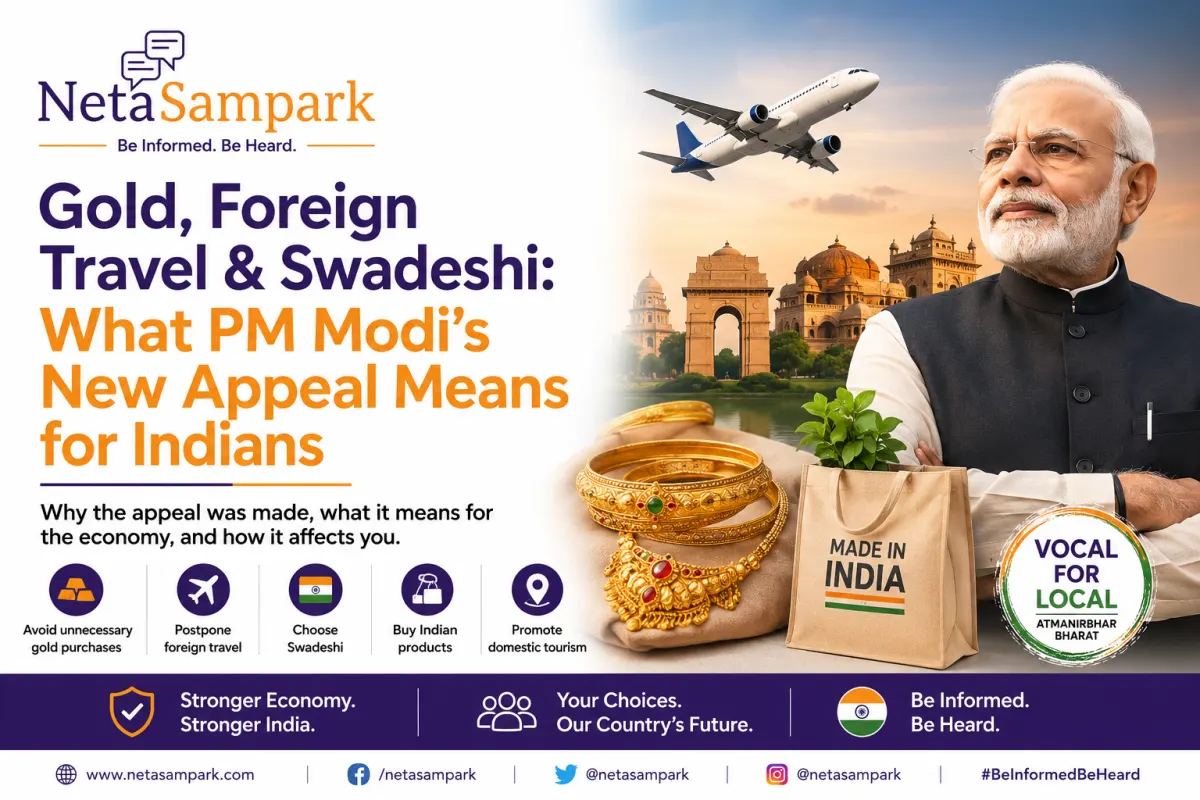
Citizens were encouraged to:
- Avoid non-essential purchases of gold
- Postpone unnecessary foreign travel
- Prefer domestic tourism
- Consider celebrating weddings and other occasions within India
- Buy Indian-made products
- Support Swadeshi and Vocal for Local
- Reduce unnecessary consumption of imported resources
The broader objective is to reduce pressure on India's foreign-exchange resources and strengthen domestic economic activity. (Prime Minister of India)
The Government has also described the broader approach as part of its Aatmanirbhar Bharat, Make in India, Swadeshi and Vocal for Local push. (Press Information Bureau)
Is This a New Rule?
No.
This distinction is critical.
There is no general government rule saying Indians cannot buy gold or cannot travel abroad.
The Prime Minister's message is a public appeal for voluntary restraint in non-essential spending, particularly where that spending results in foreign-exchange outflows.
The official PIB record from May 2026 described the Prime Minister's message as an appeal to conserve foreign exchange by avoiding unnecessary foreign travel and non-essential gold purchases. (Press Information Bureau)
Therefore, citizens should not interpret social-media posts about this as:
“Gold purchases have been banned.”
or:
“Foreign travel has been banned.”
Neither is correct.
Why Is Gold Part of the Conversation?
India has a particularly strong cultural and financial relationship with gold.
Gold is purchased for:
- Weddings
- Festivals
- Family savings
- Jewellery
- Investment
- Gifts
- Cultural traditions
But most gold consumed in India is sourced through imports.
That means when India imports gold, foreign currency is used to pay for it.
The Government's Economic Survey 2025–26 notes that gold remains one of India's major import categories. It also reported that gold imports increased 27.4% in FY2024–25, with the rise attributed partly to higher international gold prices and strong domestic consumption. (India Budget)
The Department of Commerce's Annual Report for 2025–26 also listed gold among India's largest principal import commodities. During April–November 2025, gold imports were valued at approximately US$45.26 billion, accounting for 8.79% of total imports during that period. (Commerce.gov.in)
That helps explain why gold features prominently in discussions about India's external sector.
Does Buying One Gold Chain Hurt India's Economy?
The answer requires some nuance.
A single household buying jewellery does not by itself create a meaningful macroeconomic problem.
The issue is the aggregate effect of millions of purchasing decisions.
If gold imports rise substantially across the economy, India needs to spend more foreign currency on imported gold.
The Economic Survey has previously highlighted gold's importance within India's import basket and its relationship with the merchandise trade balance. (India Budget)
So the Prime Minister's argument is essentially about collective behaviour:
One person's purchase is small. Millions of purchases together can become a significant import bill.
But Gold Imports Also Support Indian Businesses
This is an important part of the story that should not be ignored.
India has a large jewellery ecosystem involving:
- Goldsmiths
- Jewellery manufacturers
- Retail jewellers
- Artisans
- Refiners
- Designers
- Exporters
- Logistics providers
- Financial institutions
Therefore, reducing gold consumption can have effects on businesses connected to jewellery demand.
This creates a genuine economic trade-off:
Lower gold imports can help reduce foreign-exchange outflows.
But:
A sharp fall in jewellery demand can also affect businesses and employment connected to the sector.
The policy question is therefore not simply “gold is bad.”
It is about how India balances household demand for gold with its broader external-sector requirements.
Why Does Foreign Travel Matter?
Foreign travel is different from buying a physical imported product, but it can also create an external-sector outflow.
When an Indian resident spends money on:
- Overseas hotels
- Foreign restaurants
- International tourism
- Shopping abroad
- Foreign events
- Overseas weddings
- Other travel-related services
the spending is connected to imports of travel services in India's balance-of-payments framework.
The Reserve Bank of India tracks travel-related services as part of India's international services transactions. (Reserve Bank of India)
This is why the Prime Minister's appeal linked foreign travel and foreign-exchange conservation.
Again, this does not mean foreign travel is prohibited.
It means the Government is asking citizens to consider whether some discretionary overseas spending can instead happen within India.
Why “Wed in India” Is Part of the Message
A particularly interesting part of the appeal is the push toward celebrating weddings and other occasions within India.
India has a huge domestic wedding economy.
A wedding can generate spending across:
- Hotels
- Restaurants
- Transport
- Event management
- Decoration
- Photography
- Clothing
- Jewellery
- Tourism
- Local artisans
- Small businesses
If an Indian family chooses an Indian destination instead of an overseas destination, much of that spending remains within the domestic economy.
That is the economic logic behind the broader “Wed in India” and domestic-tourism message.
It is not simply about cancelling travel.
It is about where the spending takes place.
What Does Swadeshi Mean in This Context?
The word Swadeshi has a much longer history in India.
In the current policy context, the Government uses it alongside terms such as:
Aatmanirbhar Bharat
Make in India
Vocal for Local
The basic idea is to encourage consumers to prefer products made in India where suitable alternatives exist.
The Prime Minister has repeatedly linked Swadeshi with strengthening domestic manufacturing, entrepreneurship and economic self-reliance. (Prime Minister of India)
This does not mean that every imported product is bad or that India should stop trading with the world.
India's economy depends heavily on international trade.
The objective is to increase India's ability to produce competitively within the country and participate more strongly in global supply chains.
Does Buying Indian Automatically Mean More Jobs?
Not automatically.
A product being made in India does not by itself guarantee:
- Better wages
- More employment
- Better quality
- Lower prices
- Higher productivity
For Swadeshi to produce sustainable economic benefits, Indian products also need to be:
Competitive
They need to offer consumers reasonable value.
High quality
Consumers will not permanently switch simply because a product is domestic.
Innovative
Indian companies need to develop technology, design and intellectual property.
Scalable
Businesses must be able to produce efficiently at large volumes.
Exportable
The strongest version of Make in India is not merely:
“Indians buy Indian.”
It is:
“The world buys products made in India.”
Why Is This Message Coming Alongside the GDP Story?
The timing is significant.
India's latest official national accounts data shows 7.8% real GDP growth in Q1 FY2026–27.
The Prime Minister described that performance as a major achievement despite global uncertainty, oil-price shocks and supply-chain problems. (Prime Minister of India)
The Government therefore wants the current growth momentum to be supported by stronger domestic economic activity and greater resilience against external shocks.
That is where the Swadeshi message fits into the larger economic narrative.
What Does This Have to Do With Foreign Exchange?
Foreign exchange is essentially the internationally usable currency and reserve assets that India uses to make payments to the rest of the world.
India needs foreign exchange for things such as:
- Imports
- International services
- External debt payments
- Overseas investments
- Other international transactions
India also earns foreign exchange through:
- Merchandise exports
- Services exports
- Remittances
- Investment flows and other external receipts
The challenge is therefore not simply:
“India must stop importing.”
It is:
India needs to manage its external payments while increasing its ability to earn foreign exchange.
India Cannot Simply Stop Imports
This is another important nuance.
India imports many products and inputs that are essential for economic activity.
These include:
- Crude oil
- Electronics components
- Machinery
- Industrial inputs
- Chemicals
- Gold
- Other raw materials
The Department of Commerce's data shows that India's import basket includes both consumer goods and critical inputs needed by domestic industries. (Commerce.gov.in)
In fact, the Economic Survey has noted that imports of intermediate inputs and capital goods can also reflect strong domestic demand and investment. (India Budget)
Therefore, simply reducing all imports would not necessarily make India stronger.
The more meaningful objective is to reduce unnecessary import dependence while strengthening domestic production.
What Does This Mean for You as a Consumer?
The appeal ultimately comes down to a simple question:
Where does your spending go?
Suppose you have ₹5 lakh available for a discretionary purchase.
You could:
- Buy an imported product
- Take an overseas holiday
- Hold a foreign destination wedding
Or you could:
- Buy an Indian product
- Travel within India
- Celebrate an event at an Indian destination
- Support a local business
- Purchase from an Indian manufacturer
The second set of choices can keep more of that spending within India's domestic economic ecosystem.
But consumers should still make decisions based on their own circumstances.
There is no government requirement that you must cancel your holiday or stop buying gold.
Should You Stop Buying Gold?
Not necessarily.
The Prime Minister's appeal concerns non-essential or unnecessary purchases.
If gold is being purchased for a genuine requirement—such as a wedding, family need or another legitimate purpose—the broader message should not be interpreted as a prohibition.
The sensible consumer question is:
“Do I need to make this purchase now?”
rather than:
“Am I legally allowed to buy gold?”
There is a major difference.
Should You Cancel Your Foreign Holiday?
Again, there is no ban.
The appeal is about discretionary foreign-exchange spending.
If an overseas trip is already booked, unavoidable, business-related or otherwise necessary, the Government's message does not create a legal obligation to cancel it.
For discretionary travel, however, the Government is asking citizens to consider domestic alternatives.
Could This Benefit Indian Tourism?
Potentially, yes.
If some Indians who would otherwise travel abroad choose domestic destinations, the money spent could flow toward:
- Indian hotels
- Restaurants
- Airlines and railways
- Local taxis
- Tour operators
- Guides
- Handicraft sellers
- Local businesses
- State tourism ecosystems
That is one of the strongest economic arguments behind the domestic-tourism component of the appeal.
What About Indian Manufacturers?
This is arguably the most important long-term part of the message.
A temporary consumer campaign can increase demand for Indian products.
But sustained economic impact requires Indian companies to respond by improving:
Quality + Price + Innovation + Scale + Exports
If Indian consumers buy Indian products but those products remain uncompetitive internationally, the benefit is limited.
If Indian companies become globally competitive, the effect can be much larger.
The Government's broader Aatmanirbhar Bharat and Make in India approach explicitly focuses on building domestic capabilities rather than permanent isolation from global markets. (Press Information Bureau)
Is Swadeshi the Same as Boycotting Foreign Products?
No.
Swadeshi in the current policy conversation is better understood as preferential support for domestic production, rather than a blanket prohibition on foreign goods.
India remains deeply integrated into global trade.
The Government itself continues to promote exports, international investment and participation in global supply chains.
The Department of Commerce's trade data demonstrates the scale of India's international merchandise and services trade. (Commerce.gov.in)
The stronger objective is therefore:
Make Indian products good enough that consumers choose them because they are competitive—not simply because they are Indian.
What Are the Possible Benefits?
If implemented as a voluntary change in consumption behaviour, the approach could potentially:
Reduce some unnecessary import demand
Particularly in areas such as non-essential gold purchases.
Support domestic businesses
More spending within India can benefit Indian companies and local businesses.
Strengthen domestic tourism
Domestic travel keeps tourism expenditure within the Indian economy.
Encourage Indian manufacturing
Greater demand can provide a market for domestic producers.
Improve economic resilience
A diversified domestic production base can reduce vulnerability to external disruptions.
But There Are Also Limitations
Citizens should understand the other side too.
Not every imported product has an Indian substitute.
Some imported components are essential for Indian manufacturing itself.
Gold has cultural and financial significance.
A sharp fall in demand could affect the jewellery ecosystem.
Foreign travel also benefits India's global connectivity.
Business travel, education, medical travel and other international activities can have economic value.
Consumer choice matters.
People ultimately make purchases based on price, quality, need and preference.
Domestic production must remain competitive.
Simply labelling something “Made in India” does not guarantee economic success.
The Bigger Economic Question
The most important issue is not whether Indians buy one less gold chain or take one fewer foreign holiday.
The bigger question is:
Can India simultaneously increase domestic production, reduce unnecessary import dependence and become a stronger exporter?
That is a much bigger challenge.
India's latest GDP numbers provide encouraging evidence of strong economic activity, but sustained growth requires productivity, investment, manufacturing capability, employment and competitiveness to improve together.
The Government's broader economic strategy is built around exactly this combination of domestic capability and global competitiveness. (Press Information Bureau)
What Should Ordinary Citizens Take From This?
You don't need to treat the Prime Minister's message as an instruction to stop spending.
Instead, consider it as a request to make more conscious spending choices.
Before making a discretionary purchase, ask:
Do I need it?
If yes, make the purchase that makes sense for you.
Is there a good Indian alternative?
If there is, consider supporting it.
Can I travel within India instead?
If the purpose is leisure, a domestic destination may offer a comparable experience while supporting Indian businesses.
Am I buying gold because I need it—or simply because prices are rising?
That is a financial decision worth thinking about carefully.
What This Does NOT Mean
Let's clear up some of the misinformation that can arise around such appeals.
❌ Gold purchases have NOT been banned.
❌ Foreign travel has NOT been banned.
❌ Indians are NOT legally required to buy only Indian products.
❌ Foreign products have NOT been made illegal simply because the Government is promoting Swadeshi.
❌ A citizen is NOT required to cancel a foreign holiday because of the Prime Minister's appeal.
These are voluntary economic appeals, not blanket prohibitions.
Why This Conversation Matters Now
The timing gives the message additional significance.
India has just reported 7.8% real GDP growth for Q1 FY2026–27, and the Government is trying to frame the next stage of growth around domestic strength, manufacturing and resilience. (Prime Minister of India)
At the same time, India's official economic data shows that gold remains a major import category, while services—including travel—are an important part of India's external transactions. (Commerce.gov.in)
That creates the economic logic behind the appeal:
Earn more from the world.
Produce more at home.
Reduce unnecessary import dependence.
Keep more productive spending within India.
The Real Meaning of “Vocal for Local”
The strongest interpretation of Vocal for Local isn't:
“Never buy foreign.”
It is:
“Give Indian businesses a fair chance when a competitive Indian option exists.”
And for businesses, the responsibility goes the other way:
“If Indians are being encouraged to buy Indian, Indian businesses must deliver quality, value and innovation.”
That is where a consumer campaign can become a genuine economic strategy.
Final Takeaway
Prime Minister Narendra Modi's appeal to avoid non-essential gold purchases and unnecessary foreign travel, while supporting Swadeshi, Vocal for Local, domestic tourism and Indian-made products, is fundamentally about economic behaviour and foreign-exchange conservation. The Government's official communications frame it as a voluntary contribution citizens can make during a period of global uncertainty. (Prime Minister of India)
India's official economic data shows why gold is part of the discussion: gold is one of the country's major import commodities, while the country's external accounts also record spending on travel and other imported services. (Commerce.gov.in)
But this is not a call to isolate India from the world.
India needs international trade, technology, investment and global markets.
The larger objective is to build an India that can produce competitively, consume intelligently, export more and remain resilient when global conditions become difficult.
For citizens, the message is simple:
Buy what you need.
Choose Indian when there is a competitive choice.
Consider India before travelling abroad for discretionary occasions.
Think twice about unnecessary purchases.
And above all, remember:
Swadeshi works best when Indian products win because they are genuinely good—not merely because they are Indian.
Be Informed. Be Heard.
Official sources
- Prime Minister’s address on prudent consumption and Swadeshi
- PIB — Government response to the Prime Minister’s appeal
- Economic Survey 2025–26
- Department of Commerce — Annual Report 2025–26
- RBI — Services and travel transactions