
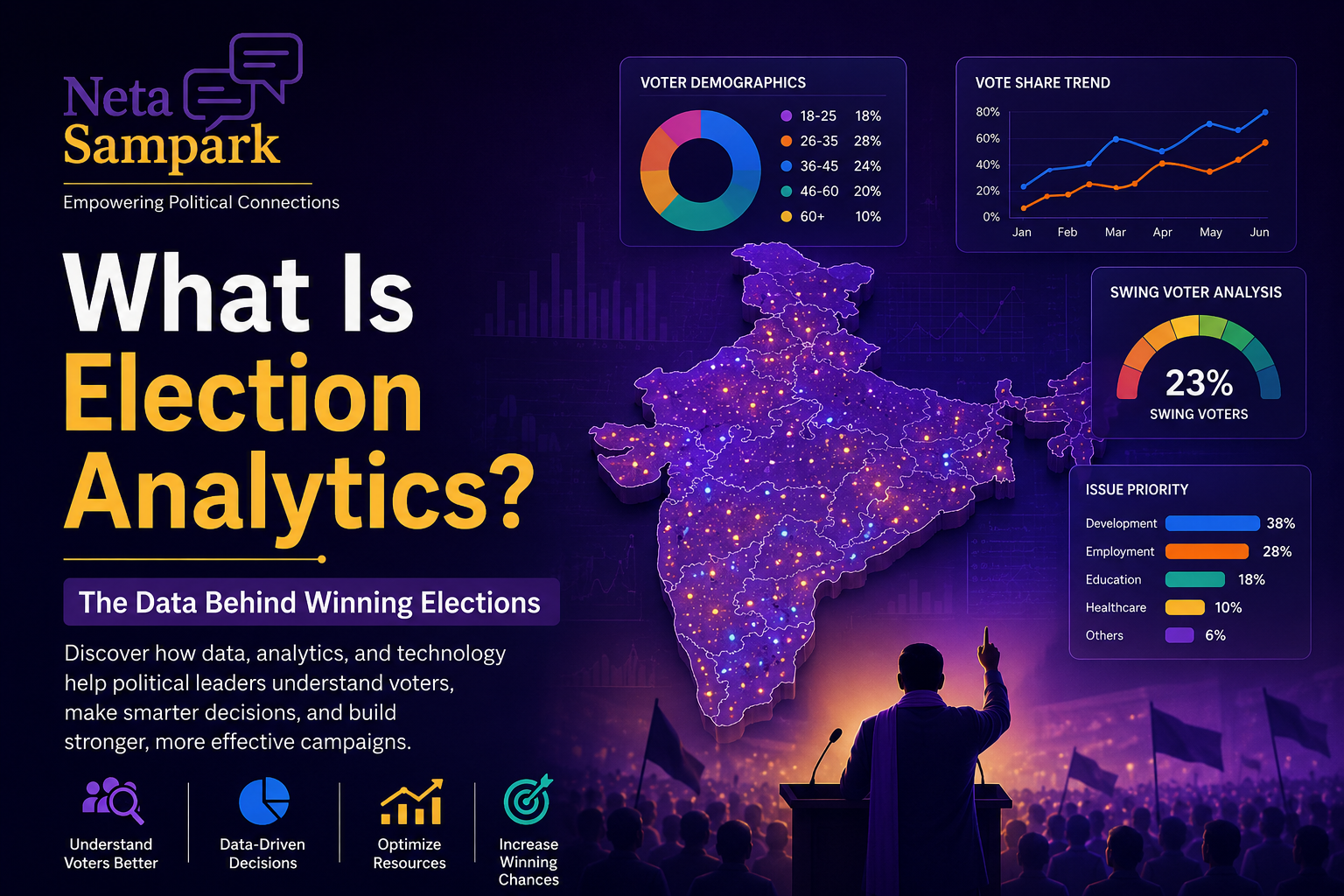
What Is Election Analytics?
How Data Is Reshaping Modern Politics
In today’s digital world, elections are no longer driven only by rallies, speeches, and intuition. Modern political campaigns increasingly rely on data, technology, and analytics to understand voters, optimize campaigns, and make strategic decisions.
This is where Election Analytics comes in.
Election analytics is the process of collecting, organizing, analyzing, and interpreting political and voter-related data to improve campaign performance, governance, outreach, and decision-making.
From booth-level insights to AI-powered voter behavior prediction, election analytics is transforming how political organizations operate.
Understanding Election Analytics
Election analytics combines:
- Political data
- Voter intelligence
- Demographic analysis
- Geographic mapping
- Campaign performance tracking
- Public sentiment analysis
- Artificial intelligence
- Predictive modeling
The primary objective is simple:
Transform political data into actionable insights.
These insights help political parties, candidates, campaign managers, governance teams, and strategists make informed decisions at every level of an election campaign.
Why Election Analytics Matters
Political campaigns generate enormous amounts of information every day.
This includes:
- Voter databases
- Booth-wise voting patterns
- Survey responses
- Social media engagement
- Public grievances
- WhatsApp communication
- Volunteer activity
- Field reports
- Geographic data
- Demographic information
Without analytics, this information remains scattered and underutilized.
Election analytics converts raw data into meaningful intelligence that can help answer critical political questions such as:
- Which booths are weak?
- Where is voter support growing?
- Which communities require stronger engagement?
- Which campaign activities are performing well?
- What are the key voter concerns in a constituency?
- Which regions need more field activity?
- Which demographic groups are likely swing voters?
Modern campaigns use these insights to improve both efficiency and effectiveness.
Core Components of Election Analytics
1. Voter Data Analysis
Voter data forms the foundation of election analytics.
Campaign teams analyze:
- Age groups
- Gender distribution
- Geographic regions
- Urban and rural segmentation
- Community demographics
- Historical voting behavior
- Constituency patterns
This helps political organizations understand voter behavior more accurately and build targeted outreach strategies.
2. Booth-Level Analytics
Booth-level analytics is one of the most important aspects of modern election strategy.
Each polling booth can be analyzed individually to identify:
- Strong booths
- Weak booths
- Swing booths
- Turnout trends
- Historical voting performance
- Volunteer efficiency
- Local political issues
This enables campaigns to focus resources where they matter most instead of running generic constituency-wide operations.
Micro-level strategy often becomes the difference between winning and losing close elections.
3. Geographic Intelligence (GIS Mapping)
Geographic Information Systems (GIS) allow political data to be visualized spatially.
Analytics platforms can map:
- Polling booths
- Constituency boundaries
- Influential regions
- Development gaps
- Public grievance clusters
- Outreach coverage
GIS-based election intelligence helps leadership teams identify patterns that are difficult to understand through spreadsheets alone.
4. Sentiment Analysis
Public sentiment is now one of the most valuable forms of political intelligence.
Modern analytics systems evaluate public opinion using:
- Social media activity
- News coverage
- Surveys
- Online discussions
- Public feedback
- Digital engagement
AI-powered sentiment analysis helps campaigns identify whether public opinion is positive, negative, or neutral in real time.
This allows faster political response and narrative management.
5. Campaign Performance Tracking
Election analytics also helps monitor operational efficiency.
Political organizations track:
- Rally attendance
- Volunteer activity
- WhatsApp engagement
- Door-to-door campaign progress
- Call center performance
- Social media reach
- Field reporting
- Public interactions
This creates measurable campaign KPIs that improve accountability and strategic planning.
How Political Parties Use Election Analytics
Modern political organizations use analytics at multiple levels.
Candidate Selection
Parties analyze:
- Ground influence
- Public perception
- Historical performance
- Social acceptance
- Local organizational strength
before selecting candidates.
Campaign Planning
Election analytics helps determine:
- Which constituencies require more focus
- Where rallies should be organized
- Which issues should be highlighted
- How campaign budgets should be allocated
Targeted Voter Outreach
Campaigns can personalize communication based on:
- Language
- Region
- Community
- Age group
- Interests
- Local issues
Personalized outreach improves voter engagement and communication effectiveness.
War Room Management
Modern election war rooms rely heavily on analytics dashboards.
Leadership teams monitor:
- Booth performance
- Ground reports
- Volunteer updates
- Public sentiment
- Media coverage
- Campaign KPIs
- Outreach performance
This enables real-time political decision-making.
The Role of AI in Election Analytics
Artificial Intelligence is rapidly transforming political operations.
AI-powered election systems can:
- Predict voter behavior
- Detect political trends
- Analyze public sentiment
- Identify issue clusters
- Generate constituency insights
- Detect campaign risks
- Automate data analysis
AI significantly improves the speed and accuracy of political intelligence.
As datasets become larger and more complex, AI-driven analytics will become increasingly important in elections.
Benefits of Election Analytics
Better Decision-Making
Data-driven insights reduce dependence on assumptions and guesswork.
Efficient Resource Allocation
Campaign budgets, manpower, and outreach efforts can be optimized.
Improved Voter Engagement
Personalized communication creates stronger voter relationships.
Faster Political Response
Real-time intelligence helps campaigns respond quickly to changing situations.
Stronger Ground Operations
Field teams can focus on high-priority booths and constituencies.
Challenges in Election Analytics
While election analytics offers major advantages, it also presents several challenges.
Data Accuracy
Incorrect or outdated data can produce misleading insights.
Privacy and Ethics
Political organizations must use voter data responsibly and ethically.
Technology Adoption
Many political teams still lack digital infrastructure and trained analytics teams.
Real-Time Data Management
Handling large-scale live political data requires robust systems and processes.
The Future of Election Analytics in India
India is rapidly moving toward technology-driven politics.
In the coming years, election analytics is expected to become essential for:
- Political campaigns
- Governance systems
- Constituency management
- Citizen engagement
- Public grievance tracking
- Policy planning
Political organizations that adopt data-driven systems early will gain significant strategic advantages.
The future of elections will increasingly depend on the ability to combine leadership, strategy, and technology effectively.
How NetaSampark Is Enabling Data-Driven Politics
NetaSampark is building technology solutions focused on:
- Election analytics
- Political intelligence
- Constituency management
- Governance systems
- Citizen engagement
- Political CRM platforms
- Real-time reporting
By combining analytics, AI, digital governance, and field intelligence, NetaSampark aims to help political organizations operate more efficiently and make smarter decisions.
Final Thoughts
Election analytics is no longer optional in modern politics.
As elections become more competitive and data-intensive, political organizations need intelligent systems capable of transforming information into actionable insights.
From booth-level strategy to AI-powered voter intelligence, election analytics is reshaping the future of political campaigns and governance.
The organizations that effectively leverage data and technology today will become the political leaders of tomorrow.